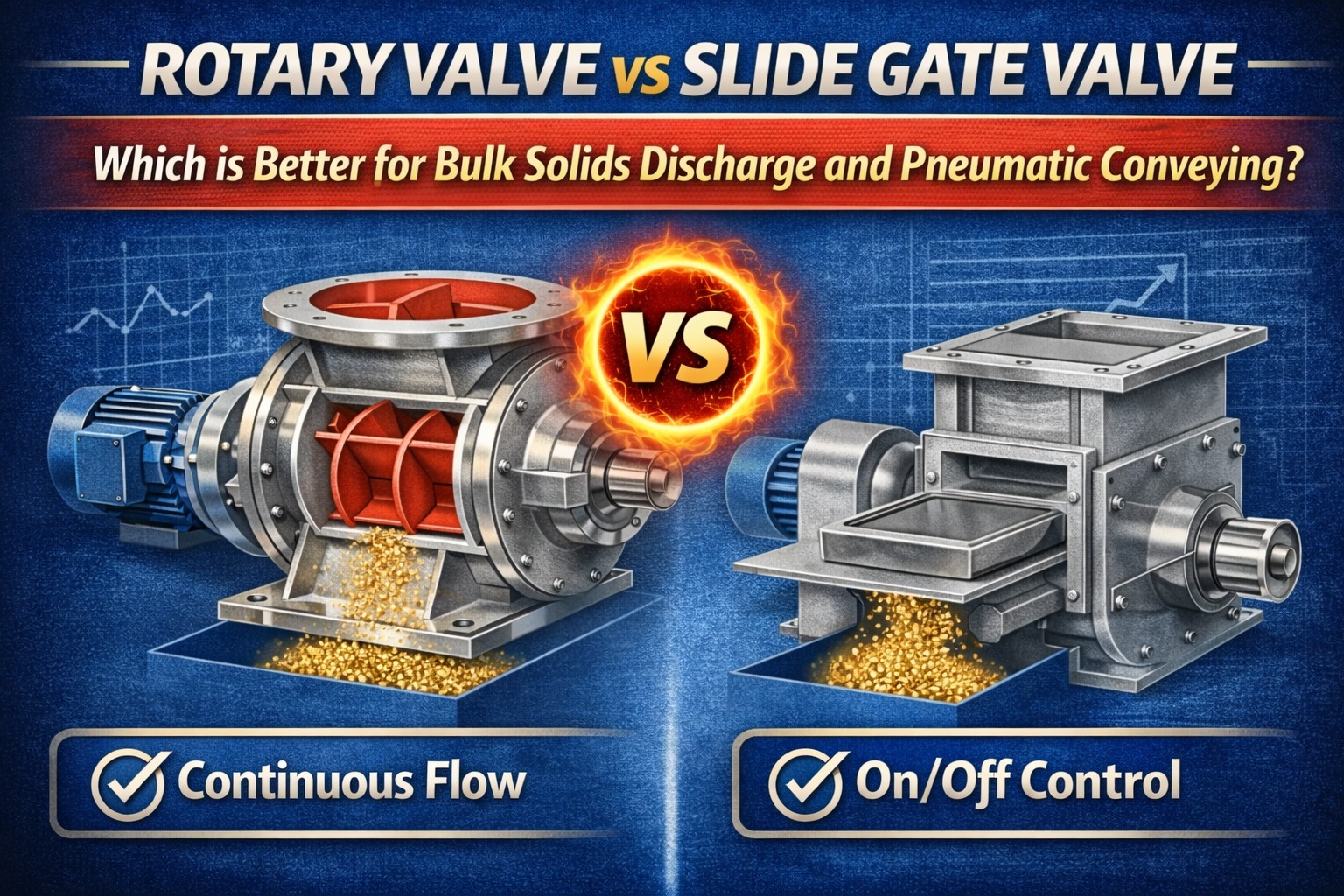
Rotary Valve vs Slide Gate Valve: Which is Better for Bulk Solids Discharge and Pneumatic Conveying?

Choosing the right valve for bulk solids discharge and pneumatic conveying has a direct influence on system efficiency, consistency of material flow, air leakage control, and overall costs of operation. If your facility is handling powders, granules, or pellets such as food processing plants in Georgia, pharmaceutical production, or chemical bulk handling all over the USA, your decision between a rotary valve (sometimes referred to as rotary airlock valve) and a slide gate valve (also known as slide gate or knife gate) will be based on your particular application requirements.

A rotary valve uses a rotating rotor with pockets to meter material continuously while maintaining a pressure seal between upstream and downstream zones. This makes it ideal for applications requiring consistent feed rates and airlock functionality. A slide gate valve employs a flat sliding plate to open, close, or partially regulate flow, excelling in on/off isolation or simple gravity discharge with minimal moving parts.

Both valves serve critical roles in dust collection hoppers, silo discharge, and pneumatic conveying lines, but neither is universally “better.” Rotary valves shine in continuous metering under pressure differentials, while slide gate valves provide reliable shutoff and lower maintenance in gravity or low-pressure scenarios. At Airlock Genius, a trusted USA-based manufacturer with in-house engineering expertise, we produce precision rotary valves in 304/316 stainless steel for demanding bulk handling. This comparison helps you decide which suits your process.

Key Design and Functional Differences

Rotary Valve (Rotary Airlock Valve)

  • Continuous rotation meters material at controlled rates.
  • Maintains partial airlock/seal against pressure differentials (typically up to 15–22 PSIG in heavy-duty models).
  • Drop-through for gravity discharge; blow-through for direct pneumatic conveying integration.
  • 8–10 vane rotors reduce leakage and improve metering accuracy.

Slide Gate Valve

  • Linear sliding plate provides full open/close or throttling.
  • Excellent for isolation, shutoff through material piles, or flow regulation in gravity systems.
  • Low-profile, minimal obstruction to flow when open.
  • Often used in dilute/dense phase conveying for line isolation or above rotary valves to reduce leakage.

Advantages and Best Applications

When Rotary Valve is Better

Rotary valves excel in scenarios requiring continuous, metered discharge and pressure management:

  • Pneumatic conveying systems (dilute or dense phase) where consistent feed into pressurized lines is essential.
  • Dust collector hopper discharge under vacuum or slight pressure to prevent air infiltration and maintain system efficiency.
  • Applications needing precise volumetric control, such as feeding extruders, mixers, or scales.
  • Combustible dust environments—tight clearances and multiple vanes help meet NFPA 660 standards for isolation and flame propagation prevention.

They handle free-flowing to moderately cohesive materials like flour, sugar, chemicals, or minerals with reliable performance.

When Slide Gate Valve is Better

Slide gate valves outperform in isolation, simplicity, and low-maintenance needs:

  • Gravity-fed discharge from silos, bins, or hoppers where on/off control or partial flow regulation suffices.
  • Shutoff above rotary valves in pneumatic conveying to minimize air leakage when not operating or during maintenance.
  • Abrasive or large-particle materials that could jam rotors—slide gates close through flowing material without damage.
  • Budget-conscious setups or systems with infrequent operation, as they have fewer moving parts and no drive motor.

They suit isolation in multi-line conveying, maintenance gates, or clear-action barriers to enhance overall system efficiency.

Performance Comparison: Discharge and Conveying Efficiency

  • Metering and Flow Control — Rotary valves provide superior continuous, volumetric metering; slide gates offer basic throttling but less precision.
  • Air Leakage and Pressure Handling — Rotary valves manage differentials better inherently; slide gates provide excellent seals when closed but no continuous airlock.
  • Maintenance and Downtime — Slide gates require less upkeep (no bearings/rotors to wear); rotary valves need periodic clearance checks and lubrication.
  • Material Compatibility — Both handle dry bulk solids, but rotary valves risk jamming with sticky/abrasive materials unless equipped with adjustable tips; slide gates cut through piles reliably.
  • Cost and Energy — Slide gates are lower initial cost and energy use (manual or actuated); rotary valves consume power for continuous rotation.

Many systems combine both: a slide gate above a rotary valve for isolation and leakage reduction in pneumatic conveying.

Conclusion

Neither a rotary valve nor a slide gate valve is universally superior—the best choice depends on your priorities. For continuous metering, pressure sealing, and pneumatic conveying feed, a rotary valve delivers unmatched performance and reliability. For simple isolation, gravity discharge, or augmenting rotary systems with better shutoff, a slide gate valve often proves more efficient and cost-effective.

In dust collection, bulk discharge, or conveying setups, evaluate material properties, pressure needs, flow requirements, and maintenance access. Proper selection prevents issues like backups, excessive leakage, or premature wear while ensuring compliance and uptime.

Airlock Genius specializes in USA-made rotary valves engineered for precision and durability in food, pharma, chemical, and bulk handling applications. Discover our rotary valve solutions tailored to your process.

Unsure which valve fits your bulk solids discharge or pneumatic conveying system? Contact our team for a free consultation on rotary valve vs slide gate valve options. Our experts will help optimize your setup for maximum efficiency and reliability.

Frequently Asked Questions

Can a slide gate valve replace a rotary valve in pneumatic conveying?

No—slide gates lack continuous metering and airlock capability; they’re better for isolation, often used in combination with rotary valves.

Which valve handles combustible dust better for NFPA compliance?

Rotary valves with tight clearances and multiple vanes provide effective isolation per NFPA 660; slide gates excel at positive shutoff but don’t meter continuously.

What if my material is abrasive or sticky?

Slide gates handle abrasion well with durable plates; rotary valves may require hardened tips or lower speeds to minimize wear.

Do rotary valves consume more energy than slide gates?

Yes—continuous rotation requires motor power, while slide gates use energy only during actuation.
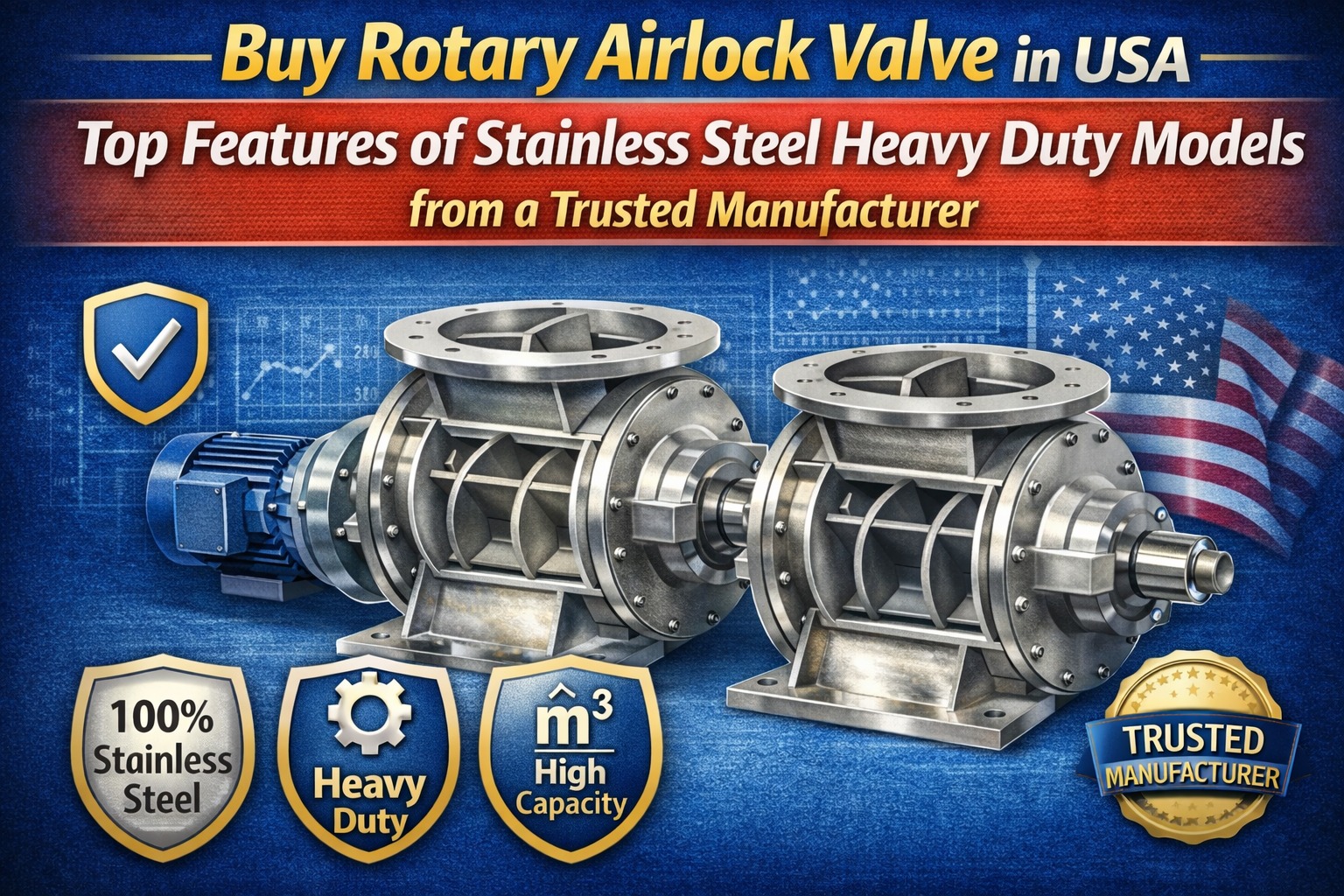
Buy Rotary Airlock Valve in USA: Top Features of Stainless Steel Heavy Duty Models from a Trusted Manufacturer

Buying a rotary airlock valve in the USA? If you want to be sure of quality, speed of delivery, and meeting North American standards, then a heavy-duty stainless steel model made by a local manufacturer is a great choice. Across the United States, food processing pharmaceutical chemical, bulk material handling, and dust collection facilities from Georgia flour mills to Midwest chemical plants depend on durable rotary airlock valves not only for maintaining pressure differences, but also for accurate material metering, and most importantly, for safety and avoiding downtime which could be very costly. Heavy-duty stainless steel rotary airlock valves combine a great performance when handling abrasive, corrosive, or strictly hygienic environments where carbon steel alternatives are not adequate, with the provision of a very durable product, easy cleaning, and the lack of rust or contamination – very important characteristics for FDA/USDA-regulated processes and dust systems compliant with NFPA – thanks to the use of either 304 or 316 stainless steel.

Airlock Genius, a USA-based brand you can trust that also has in-house engineering and machining capabilities, is a maker of precision heavy-duty rotary airlock valves that are capable of serving for a long time and require little maintenance. Purchasing a rotary airlock valve in USA from us means you receive not only the quality of American-made products but also the support of experts. This article shows you the main points of our stainless steel range why they are the first choice for the most challenging applications.

1. Premium 304/316 Stainless Steel Construction

The foundation of any high-performance rotary airlock valve in USA is the material. Our heavy-duty models use 304 stainless steel for general corrosion resistance or 316 stainless steel (with molybdenum) for enhanced protection against chlorides, acids, and aggressive chemicals.

  • Full housing, rotor, and endplates in stainless—no cast iron or mild steel components
  • Sanitary finishes available (e.g., 32 Ra or better) for food and pharma
  • Welded or bolted designs with smooth, crevice-free interiors to meet hygiene standards

This construction withstands washdowns, abrasive materials like minerals or sugar, and corrosive dusts, extending service intervals significantly compared to lesser alloys.

2. Precision-Machined Tight Clearances and Rotor Design

Accurate rotor-to-housing clearances (typically 0.004–0.006 inches) are non-negotiable for minimizing air leakage and maintaining system efficiency. Our heavy-duty rotary airlock valves feature:

  • CNC-machined rotors with adjustable or fixed replaceable tips
  • 8- or 10-vane configurations for reduced pocket-to-pocket carryover and lower leakage
  • Outboard bearings isolated from material flow to prevent contamination and extend bearing life

These tolerances help meet NFPA 660 requirements for dust hazard isolation, ensuring the valve acts as an effective flame propagation barrier in combustible dust applications.

3. Heavy-Duty Drive and Bearing Systems

Industrial environments demand components that handle continuous duty and high loads. Key features include:

  • Heavy-duty pillow block or outboard bearings rated for severe service
  • Chain or direct-drive options with oversized shafts to resist deflection
  • TEFC or explosion-proof motors matched to your power requirements

These elements reduce vibration, prevent premature failure, and support higher differential pressures (up to 20 PSIG or more in custom configurations).

4. Quick-Clean and Maintenance-Friendly Options

Downtime costs thousands per hour in high-output plants. Our rotary airlock valve in USA lineup includes quick-clean designs with:

  • Rail-mounted rotors for tool-less removal and full access in minutes
  • Drop-out or hinged endplates for rapid inspection and washdown
  • Replaceable wear liners and tips for abrasive applications

These features accelerate cleaning during product changeovers or sanitation—essential in allergen-controlled food processing lines.

5. Custom Engineering and USA-Made Support

When standard models don’t fit, customization matters. Airlock Genius offers:

  • Sizes from 6″ to 24″ with round or square flanges
  • Special coatings, seals, or purge ports for extreme conditions
  • In-house engineering for application-specific sizing and modifications

Buying from a USA manufacturer means shorter lead times, easier parts access, and responsive technical support—no overseas delays or language barriers.

Explore our full range of heavy-duty rotary airlock valve in USA solutions engineered for your industry.

Conclusion

When it’s time to buy a rotary airlock valve in USA, prioritize stainless steel heavy-duty models that deliver durability, precision, low leakage, and easy maintenance. Features like 316 construction, tight clearances, robust bearings, quick-clean designs, and domestic engineering support provide the reliability needed for uninterrupted production and regulatory compliance.

Airlock Genius stands behind every valve we build with American craftsmanship and expertise. Whether upgrading a dust collector, pneumatic conveying line, or bulk feeding system, our rotary airlock valves help you achieve peak performance and longevity.

Ready to invest in a trusted, USA-made solution? Contact our team for a free consultation and get expert guidance on selecting the right heavy-duty rotary airlock valve in USA for your operation.

Frequently Asked Questions

Why choose 316 over 304 stainless steel for rotary airlock valves?

316 offers superior resistance to pitting and corrosion from chlorides or harsh chemicals, making it ideal for pharmaceutical, chemical, and marine-influenced environments.

What differential pressures can heavy-duty stainless models handle?

Standard models support up to 15 PSIG; custom heavy-duty configurations often exceed 20 PSIG with reinforced shafts and seals.

Are these rotary airlock valves suitable for food-grade applications?

Yes—304/316 construction with sanitary finishes meets FDA and USDA requirements for direct food contact.

How soon can I receive a custom rotary airlock valve from a USA manufacturer?

Lead times vary by size and customization, but domestic production typically delivers in 4–12 weeks—much faster than imported alternatives.

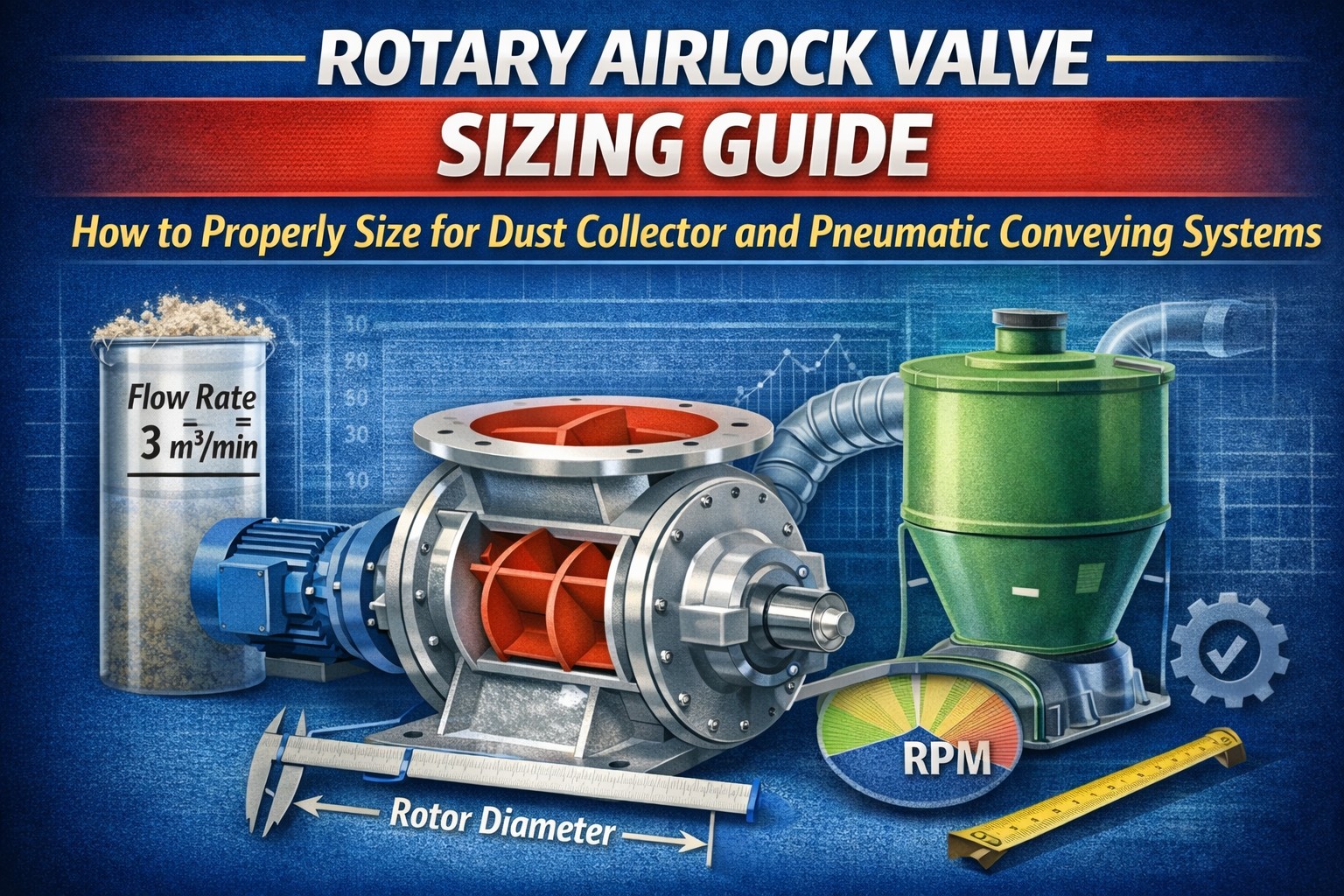
Rotary Airlock Valve Sizing Guide: How to Properly Size for Dust Collector and Pneumatic Conveying Systems

Correct sizing of rotary airlock valve is very important cosine it is the only assurance we have for reliable performance of our dust collection and pneumatic conveying systems. If you size the rotary airlock valve incorrectly, it may result in more air leakage, reduced material throughput, early wear, or even safety risks especially in combustible dust environments which are mainly found in food processing pharmaceuticals chemicals, and woodworking facilities in the USA.

Rotary airlock valve in dust collectors is the one that controls vacuum integrity while at the same time releasing the collected fines from hoppers. In pneumatic conveying, it is the valve that introduces bulk materials into pressurized lines and at the same time prevents blowback. Understanding rotary airlock valve sizing parameters such as volumetric capacity, pressure differential, material characteristics, and rotor speed is critical to achieving a fine balance between efficiency and downtime reduction.

Based in USA and with in-house engineering expertise, Airlock Genius is a manufacturer of 304/316 stainless steel rotary airlock valves for demanding applications. This guide is a step-by-step tutorial for rotary airlock valve sizing, containing formulas, major considerations for dust collection and conveying, and examples.

Key Factors in Rotary Airlock Valve Sizing

Several variables influence rotary airlock valve sizing:

  • Material bulk density (lb/ft³ or kg/m³)—measured on-site for accuracy.
  • Required throughput (mass rate, e.g., lb/hr or tons/hr).
  • Valve efficiency/fill factor (E, decimal 0.65–0.95)—accounts for incomplete pocket filling.
  • Rotor speed (RPM)—typically 15–40 RPM to avoid centrifugal effects or excessive wear.
  • System type—drop-through for dust collectors; blow-through for pneumatic conveying.
  • Pressure differential—higher pressures reduce fill efficiency due to leakage.

For dust collection, focus on low leakage and NFPA compliance. In pneumatic conveying, prioritize pressure sealing and consistent metering.

Step-by-Step Sizing Process

Step 1: Determine Required Volumetric Capacity

Convert mass rate to volume using bulk density and efficiency:

C = R / (D × E)

Where:

  • C = Required volumetric capacity (ft³/hr or m³/hr)
  • R = Required conveying rate (lb/hr or kg/hr)
  • D = Bulk density (lb/ft³ or kg/m³)
  • E = Efficiency/fill factor (decimal)

For positive pressure conveying, de-rate E to 0.65–0.70 due to air leakage. Gravity-fed dust collector applications often use 0.80–0.90.

Step 2: Calculate Capacity per Revolution

Divide by rotor speed:

Capacity per rev = C / (S × 60)  (ft³/rev, since 60 min/hr)

Select a valve size from manufacturer tables with sufficient swept volume per revolution at your target RPM.

Step 3: Choose Valve Type and Features

  • Dust collection: Drop-through design, outboard bearings, tight clearances (0.004–0.006 in) for NFPA compliance.
  • Pneumatic conveying: Blow-through or drop-through with adapter; consider 10-vane rotors for reduced leakage at higher pressures (up to 15–20 PSIG).

Reference standards like NFPA 660 for dust hazard isolation requirements, including rotor-to-housing clearances under 0.0079 in and multiple vanes in contact.

(Insert chart of typical rotary airlock valve capacities by size here. Alt text: Rotary airlock valve sizing chart showing cubic feet per revolution vs. valve diameter for dust collection and conveying)

Step 4: Validate for System Conditions

  • Measure actual bulk density.
  • Account for abrasiveness (upsize for lower RPM).
  • Ensure compliance: Outboard bearings, flame propagation barriers if needed.

Example 1: Dust Collector Application (Imperial Units)

A woodworking dust collector needs to discharge sawdust at R = 6,000 lb/hr, bulk density D = 20 lb/ft³, efficiency E = 0.85 (good flow, vacuum system).

C = 6,000 / (20 × 0.85) = 6,000 / 17 = 353 ft³/hr

At S = 20 RPM:

Per rev: 353 / (20 × 60) ≈ 0.294 ft³/rev

Select an 12–14 inch valve with ~0.3 ft³/rev capacity. This ensures reliable discharge without excessive speed or leakage.

Example 2: Pneumatic Conveying System (Metric Units)

Conveying plastic pellets at R = 8,000 kg/hr, density D = 550 kg/m³, E = 0.70 (positive pressure, some leakage).

C = 8,000 / (550 × 0.70) = 8,000 / 385 ≈ 20.8 m³/hr

At S = 25 RPM:

Per rev: (20.8 / 60) / 25 ≈ 0.0139 m³/rev (~13.9 liters/rev)

Choose a blow-through model matching this volume, with pressure rating for the system.

(Insert photo of blow-through rotary airlock valve here. Alt text: Blow-through rotary airlock valve sized for pneumatic conveying system with adapter connection)

Common Sizing Mistakes to Avoid

  • Ignoring pressure effects on fill factor.
  • Using theoretical 100% fill without de-rating.
  • Oversizing (increases leakage) or undersizing (causes backups).
  • Neglecting material abrasiveness or NFPA requirements in dust applications.

Conclusion

Effective rotary airlock valve sizing ensures optimal material flow, pressure sealing, and system safety in dust collection and pneumatic conveying. Start with accurate bulk density and throughput, apply the formula C = R / (D × E), adjust for efficiency and RPM, then select based on application type and compliance needs.

Proper sizing reduces energy costs, extends equipment life, and prevents costly downtime. As a trusted USA-based manufacturer, Airlock Genius offers expert support and customizable rotary airlock valves for your specific requirements.

Explore our rotary airlock valve sizing resources or get personalized recommendations.

Ready to size the right valve for your dust collector or conveying system? Contact our team for a free consultation on your rotary airlock valve sizing needs.

Frequently Asked Questions

How does pressure differential impact rotary airlock valve sizing?

Higher differentials reduce fill efficiency; de-rate E to 65–70% in positive pressure systems to account for leakage.

What clearances are required for NFPA-compliant rotary airlock valves in dust applications?

Rotor-to-housing clearances should stay under 0.0079 inches, ideally 0.004–0.006 inches, with multiple vanes in contact.

Should I upsize for abrasive materials?

Yes—larger valves allow lower RPM, reducing wear while maintaining capacity.

How often should bulk density be verified for accurate sizing?

Always measure on-site, as variations in moisture or compaction affect calculations significantly.

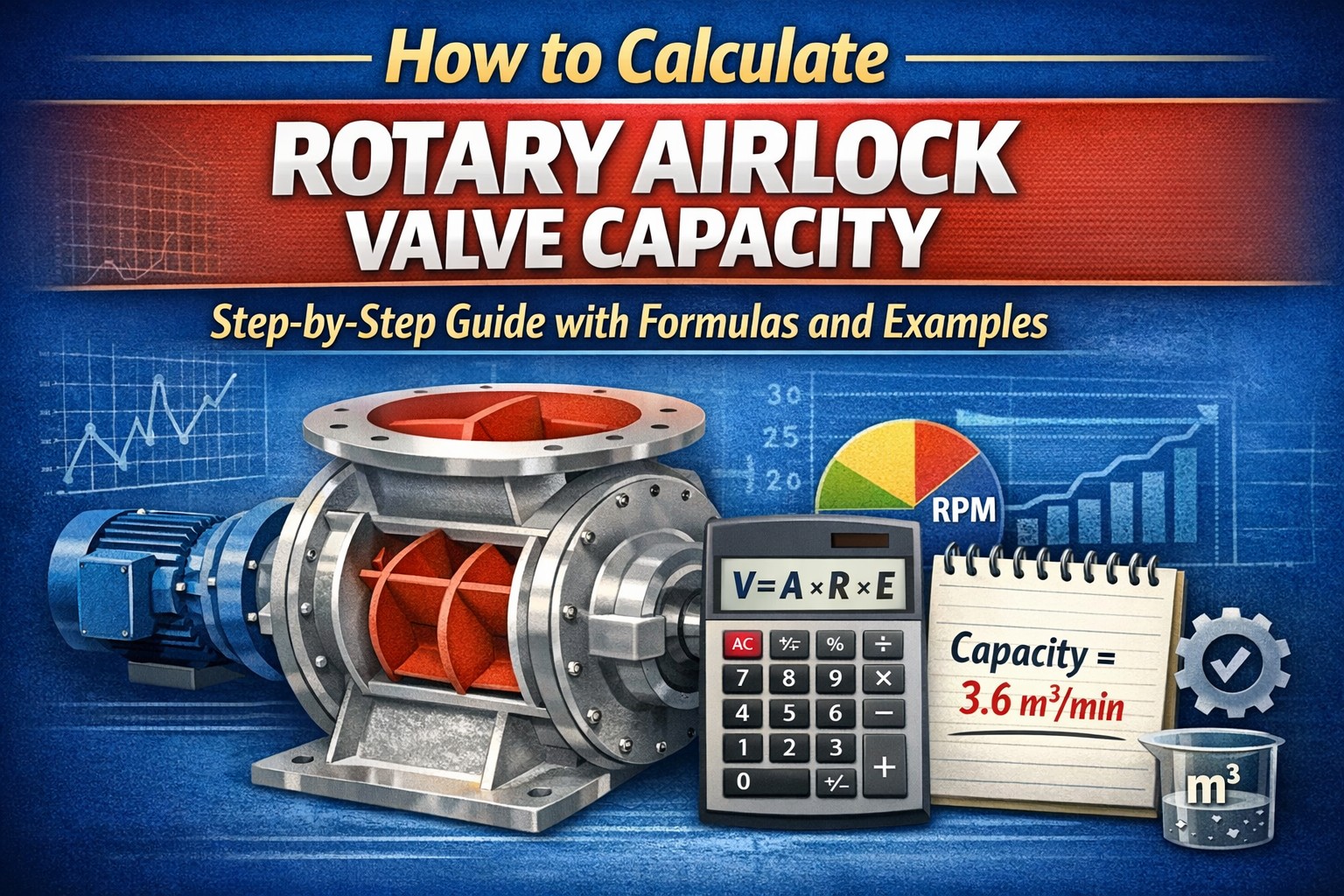
How to Calculate Rotary Airlock Valve Capacity: Step-by-Step Guide with Formulas and Examples

Proper sizing of a rotary airlock valve plays a major role in maintaining steady flow of materials, preventing system overloading and also minimizing downtime of bulk handling operations. Whether you are an engineer drawing up a pneumatic conveying system for bakery flour in Georgia, or a chemical powder production manager in a pharmaceutical plant; understanding rotary airlock valve capacity will assist you further to make sure your valve has enough capacity to supply the required throughput without suffer from excessive wear, air leaking or inefficiency.

Capacity of a rotary airlock valve is the volumetric amount of material a valve can move in unit time – generally measured in ft/hr or m/hr. It depends on the rotor volume swept, speed of rotation, bulk density, and the degree of the valve being filled quantitatively. Oversizing wastes energy and increases leakage, while undersizing results in backups and reduced production.

Airlock Genius, based in the USA, with engineering capabilities in-house, manufactures precisely-engineered rotary airlock valves in 304/316 stainless steel that are customized to the requirements of food processing pharmaceuticals chemicals and dust collection. Here we explain how to work out the capacity of a rotary airlock valve step-by-step using formulas and examples:

Step 1: Understand the Key Variables

Before calculating rotary airlock valve capacity, gather these essential parameters:

  • R — Required conveying rate (mass flow rate, e.g., lb/hr or kg/hr)
  • D — Bulk density of the material (lb/ft³ or kg/m³)
  • E — Valve efficiency (fill factor as a decimal, typically 0.65–0.95)
  • S — Rotor speed (revolutions per minute, RPM)
  • C — Required volumetric capacity (ft³/hr or m³/hr)

Efficiency (E) accounts for incomplete pocket filling due to material characteristics, pressure differential, and air leakage. For free-flowing products, use 80–95%; for sluggish or aerated materials in positive pressure systems, de-rate to 65–70%.

Step 2: Calculate Required Volumetric Capacity

The standard formula for required rotary airlock valve capacity (swept volume) is:

C = R / (D × E)

This gives the volumetric flow needed in ft³/hr (or m³/hr). It represents the total displaced volume per hour to achieve your mass throughput, adjusted for fill efficiency.

To find the capacity per revolution (ft³/rev), divide by rotor speed:

Capacity per revolution = C / (S × 60)  (since there are 60 minutes in an hour)

Many manufacturers publish theoretical capacity tables based on 100% fill, then apply efficiency.

Step 3: Determine Rotor Speed and Valve Size

Once you have C, select a valve size with sufficient capacity per revolution at an acceptable RPM (usually 15–40 RPM to avoid centrifugal force issues or excessive wear). Cross-reference against manufacturer data.

The full sizing formula incorporating RPM is often expressed as:

C = R / (D × E × S)  (where C is in ft³/min or adjusted units)

This helps verify if your chosen valve at a given speed meets the requirement.

For detailed sizing, consult resources like the Prater Industries rotary airlock sizing guide, which explains fill factor adjustments for positive vs. negative pressure systems.

Example 1: Flour in Food Processing (Imperial Units)

Suppose your system needs to convey flour at R = 10,000 lb/hr, with bulk density D = 35 lb/ft³. Assume efficiency E = 0.80 (good flowability, gravity feed).

Step 1: Calculate required volumetric capacity

C = 10,000 / (35 × 0.80) = 10,000 / 28 = 357 ft³/hr

Step 2: Target rotor speed S = 25 RPM

Capacity needed per minute: 357 / 60 ≈ 5.95 ft³/min

Per revolution: 5.95 / 25 ≈ 0.238 ft³/rev

Select a valve with at least 0.24 ft³/rev capacity (e.g., a 10-inch or 12-inch model, depending on manufacturer tables). Adjust RPM if needed for an exact match.

Example 2: Chemical Powder (Metric Units)

For a pharmaceutical application conveying powder at R = 5,000 kg/hr, bulk density D = 600 kg/m³, efficiency E = 0.70 (due to slight aeration).

C = 5,000 / (600 × 0.70) = 5,000 / 420 ≈ 11.9 m³/hr

At S = 20 RPM, capacity per revolution: (11.9 / 60) / 20 ≈ 0.0099 m³/rev (about 9.9 liters/rev).

Choose a valve size matching this swept volume from your supplier’s catalog.

Step 4: Validate and Adjust

  • Measure actual bulk density on-site for accuracy.
  • Factor in system pressure: Positive pressure systems often require lower fill factors due to blowback.
  • Always follow lockout/tagout during inspections and consult manufacturer data for precise pocket volumes.

At Airlock Genius, our rotary airlock valve capacity tools and engineering support simplify this process for optimal performance.

Conclusion

Calculating rotary airlock valve capacity accurately prevents under- or over-sizing, ensuring reliable material metering, minimal air leakage, and compliance in regulated industries. Start with the core formula C = R / (D × E), incorporate rotor speed, and cross-check against real-world conditions and manufacturer specifications.

Proper sizing extends valve life, reduces energy use, and maintains system efficiency. As a USA-based leader in precision rotary airlock valves, Airlock Genius offers expert guidance and customizable solutions for your bulk handling challenges.

Need help sizing your next rotary airlock valve? Contact our team for a free consultation and personalized capacity recommendations.

Frequently Asked Questions

What is the typical fill efficiency for rotary airlock valves?

It ranges from 65% to 95%, with 80% common for free-flowing materials in gravity feed applications.

How does pressure differential affect rotary airlock valve capacity?

Higher differentials reduce fill efficiency due to air leakage; de-rate E to 65–70% in positive pressure systems.

Can I calculate rotary airlock valve capacity without RPM?

Yes—first find required C, then select size and RPM to match from capacity tables.

Why measure bulk density on-site?

Variations in moisture, compaction, or aeration can significantly impact actual capacity calculations.

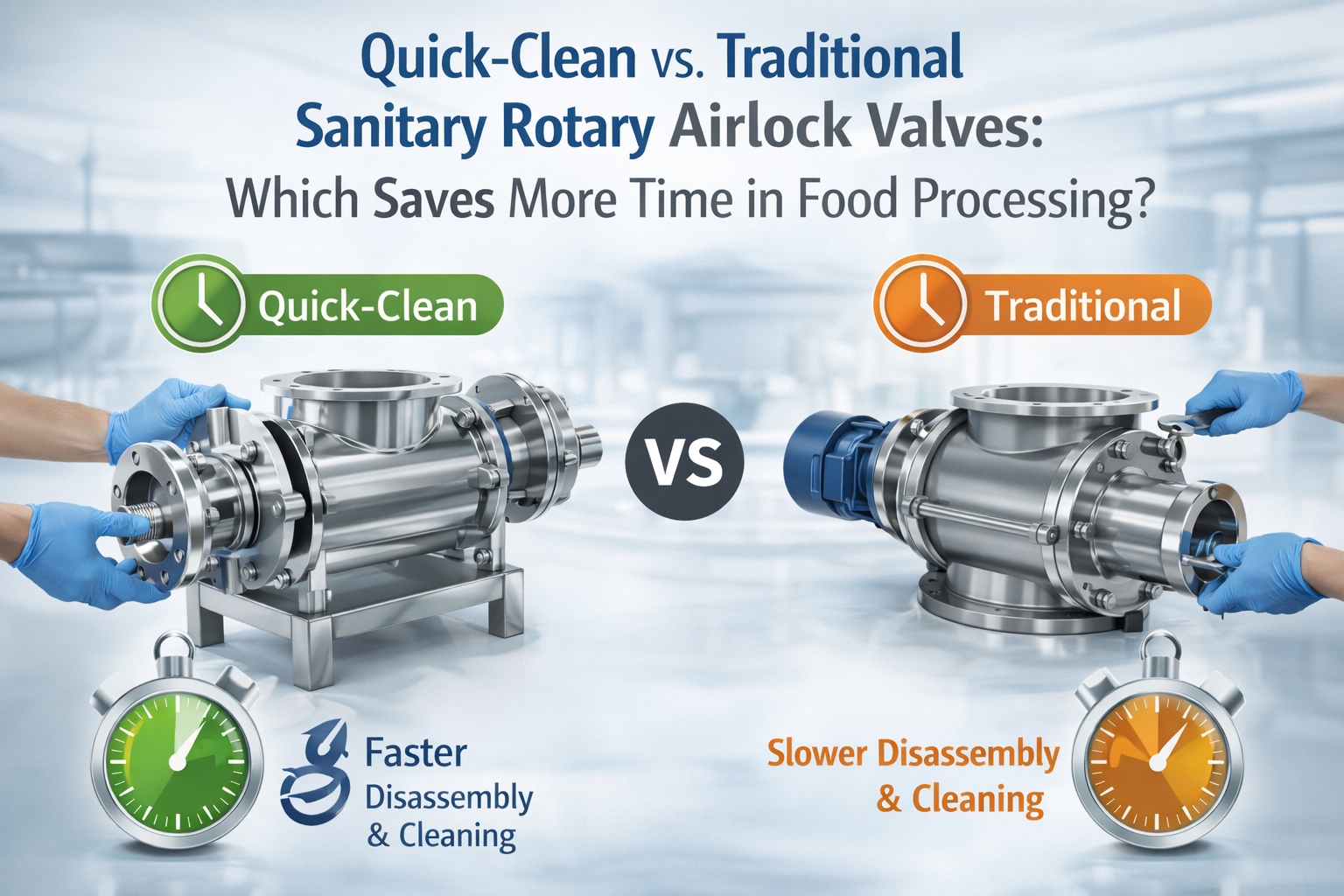
Quick-Clean vs. Traditional Sanitary Rotary Airlock Valves: Which Saves More Time in Food Processing?

From the flour and sugar handling areas of bakeries in Georgia to the dairies in the Midwest, sanitary rotary airlock valves are a critical component in maintaining the cleanliness standards, preventing cross-contamination, and providing continuous bulk material flow in pneumatic conveying and dust collection systems in food processing plants throughout the United States. Sanitary rotary airlock valves must not only meet the stringent FDA, USDA, and sanitary standards, but they also have to be capable of minimum downtime during the frequent cleaning for product changeovers or daily sanitation.

Usually, sanitary rotary airlock valves that are quite common in the industry often drop-through or fixed designs made of 304/316 stainless steel have been reliable for years. However, they require quite a long disassembly time and as a result tools rotor removal, and exact re-alignment to maintain tight clearances and avoid leaks or contamination risks are needed.

Quick-clean sanitary rotary airlock valves, incorporating features like rail systems or tool-less access, help to tackle these issues directly. Made for very clean environments, they allow faster inspection, cleaning, and reassembling without sacrificing efficiency or compliance.

Airlock Genius, a dependable USA manufacturer with engineering experience in house, is the one to turn to for highly accurate sanitary rotary airlock valves made of stainless steel, including quick-clean versions that focus on saving time and increasing efficiency. This comparison looks at which type of design really leads to more time savings in actual food processing operations.

Key Differences in Design and Cleaning Process

Traditional Sanitary Rotary Airlock Valves

These sanitary rotary airlock valves typically feature bolted endplates and fixed rotors. Cleaning requires:

  • Full system shutdown and lockout/tagout
  • Disassembly of multiple bolts and connections
  • Careful rotor extraction to prevent damage or misalignment
  • Manual cleaning of housing interiors and pockets
  • Re-gapping and reassembly with torque specifications

This process often takes 1–2 hours or more per valve, especially in larger sizes or when validating cleanliness for allergen control or regulatory audits. Downtime accumulates quickly in multi-shift operations with frequent product switches.

Quick-Clean Sanitary Rotary Airlock Valves

Quick-clean models incorporate features like RotorRail™-style systems, quick-release clamps, or hinged designs for tool-less access. Operators can:

  • Slide the rotor out on integrated rails without disconnecting convey lines
  • Gain full access to housing interiors and rotor pockets
  • Perform thorough washdown or wipe-down in minutes
  • Reassemble precisely without re-measuring clearances

Many designs allow disassembly, cleaning, and reassembly in 20–30 minutes—or as little as 2 minutes for basic access in some advanced models. This dramatic reduction stems from eliminating complex re-alignment steps and reducing labor needs.

Time Savings and Downtime Impact

The primary advantage of quick-clean sanitary rotary airlock valves lies in reduced cleaning time. Industry examples show traditional valves requiring 90+ minutes for full sanitation, while quick-clean versions cut this to 20 minutes or less—a savings of 70+ minutes per cleaning cycle.

At a conservative $500 per hour downtime cost (common in food processing for lost production and labor), cleaning one traditional valve costs around $750 in lost productivity. The same cycle with a quick-clean design drops to about $167, delivering over $580 in savings per event. For facilities cleaning multiple valves weekly, annual savings reach tens of thousands.

Beyond direct time, quick-clean designs reduce operator fatigue and injury risk during heavy lifting or awkward disassembly. They also support faster product changeovers—critical in allergen-sensitive lines—and improve audit readiness with easier validation of clean surfaces.

When Each Type Makes Sense

Traditional sanitary rotary airlock valves remain suitable for:

  • Low-frequency cleaning applications
  • Budget-constrained installations with stable product runs
  • Systems where space limits rail additions

Quick-clean sanitary rotary airlock valves excel in:

  • High-sanitation environments (dairy, baking, nutraceuticals)
  • Facilities with daily or multi-shift cleanings
  • Operations prioritizing uptime and regulatory compliance

Many processors upgrade to quick-clean models during expansions or retrofits to capture immediate ROI through reduced downtime.

Conclusion

For most modern food processing operations, quick-clean sanitary rotary airlock valves save significantly more time than traditional designs. The ability to perform fast, tool-less cleaning and reassembly translates to less downtime, lower labor costs, improved safety, and better compliance with hygiene standards—all while maintaining the reliable airlock performance needed for efficient material handling.

While traditional sanitary rotary airlock valves offer dependable service in simpler setups, the time and cost advantages of quick-clean technology make them the smarter long-term choice for high-output, sanitation-focused facilities.

Airlock Genius specializes in USA-made sanitary rotary airlock valves, including advanced quick-clean configurations engineered for food industry demands. Explore our sanitary rotary airlock valves to find the right fit for your process.

Ready to reduce cleaning time and boost productivity? Contact our team for a free consultation on your sanitary rotary airlock valve needs. Our experts can help you select the design that delivers maximum time savings in your operation.

Frequently Asked Questions

How much time can quick-clean sanitary rotary airlock valves save per cleaning?

Typically 60–90 minutes per valve compared to traditional designs, depending on size and process requirements.

Are quick-clean sanitary rotary airlock valves USDA/FDA compliant?

Yes—constructed from 304/316 stainless steel with smooth finishes and tool-less access, they meet stringent sanitary and food-grade standards.

Do quick-clean designs compromise performance or durability?

No—precision engineering maintains tight clearances, low leakage, and robust operation equivalent to traditional models.

When should I upgrade to a quick-clean sanitary rotary airlock valve?

If your facility experiences frequent cleanings, product changeovers, or high downtime costs from maintenance, quick-clean offers clear advantages.

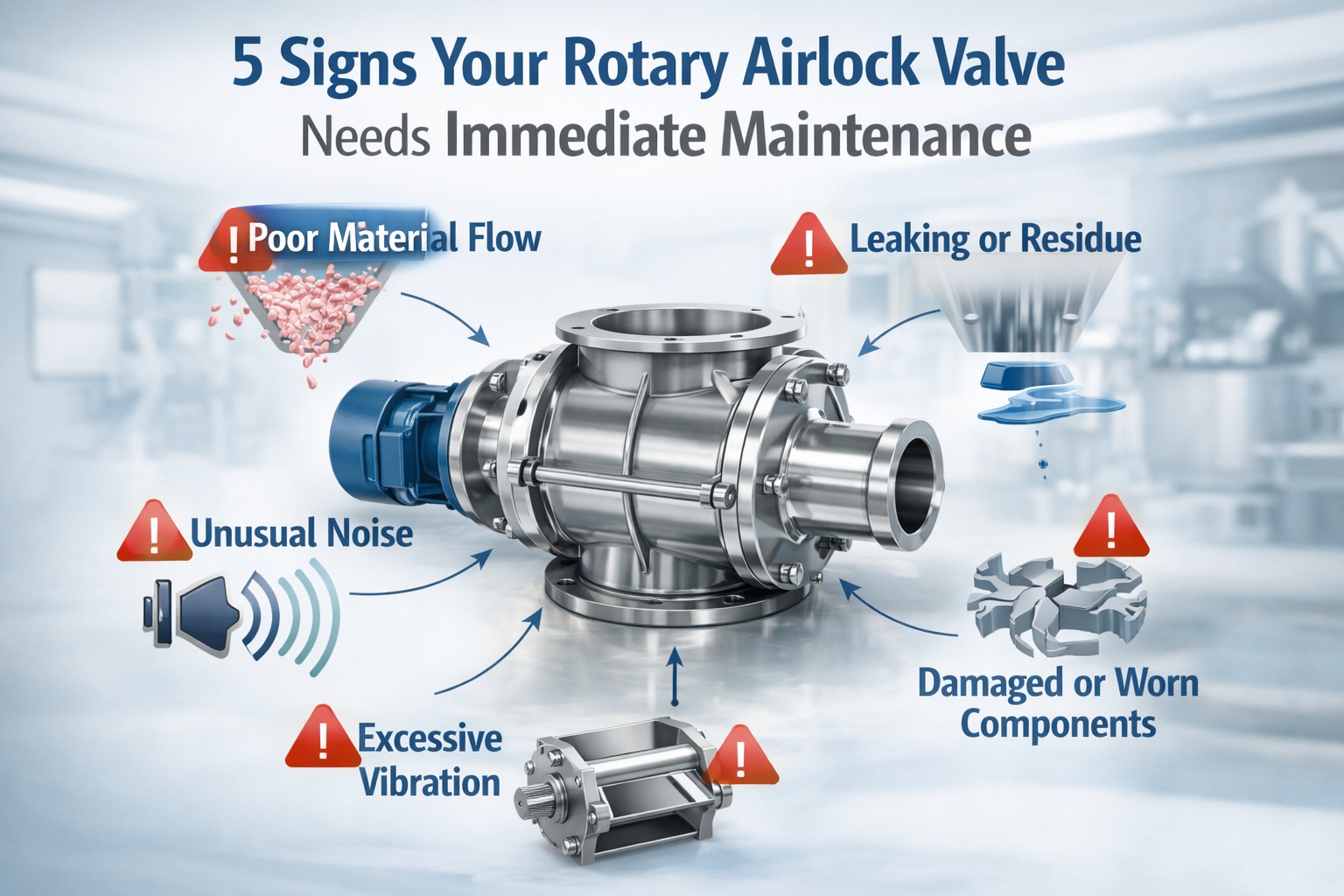
5 Signs Your Rotary Airlock Valve Needs Immediate Maintenance

Unexpected downtime in bulk material handling can cost thousands in lost production, wasted product, and emergency repairs. For engineers and plant managers in food processing, pharmaceuticals, chemicals, dust collection, and bulk solids systems across the USA, a failing rotary airlock valve often triggers these crises. Whether feeding flour in a Georgia bakery or conveying chemical powders in a Midwest facility, your rotary airlock valve maintains pressure differentials, prevents air leakage, and ensures consistent material flow. When it falters, efficiency drops, safety risks rise, and compliance with combustible dust standards becomes urgent.

A reliable rotary airlock valve is the unsung hero of pneumatic conveying and dust collection systems. It isolates high- and low-pressure zones while metering bulk materials precisely. Ignoring early warning signs leads to rotor wear, seal failure, or complete system shutdowns. At Airlock Genius, a trusted USA-based manufacturer with in-house engineering expertise, we specialize in precision-engineered, Made-in-USA rotary airlock valves built from durable 304 or 316 stainless steel to withstand abrasive and corrosive environments.

Our solutions help facilities minimize downtime and maintain peak performance. If your rotary airlock valve shows any of the following signs, immediate maintenance is essential. Discover more about our rotary airlock valve solutions designed for your industry.

(Insert diagram of rotor clearance measurement here. Alt text: Measuring rotor clearance tolerances on a rotary airlock valve for maintenance diagnostics)

1. Unusual Noises or Vibrations

Grinding, squealing, or excessive vibration from your rotary airlock valve signals immediate trouble. These sounds often stem from worn rotor tips, misaligned bearings, or material buildup in the pockets. In high-volume food processing lines, this noise can escalate quickly, stressing the drive motor and adjacent equipment.

As a USA-based manufacturer, we recommend inspecting rotor-to-housing clearances right away—typical tolerances range from 0.004 to 0.006 inches. Always follow lockout/tagout procedures before opening the valve. Addressing this early prevents costly bearing replacements and keeps your system running smoothly.

2. Visible Material Leakage or Air Blowback

Dust escaping around the rotary airlock valve housing or reverse airflow through the inlet indicates seal degradation or enlarged clearances. This common issue in pharmaceutical and chemical plants wastes product and creates combustible dust hazards.

According to the NFPA 660 standard, maintaining tight rotor clearances is critical for flame propagation isolation in dust collection systems. Check endplate seals and replace worn components with precision-machined 316 stainless replacements. Quick intervention restores the airlock function and protects downstream filters.

(Insert photo of material leakage here. Alt text: Air blowback and dust leakage from a faulty rotary airlock valve)

3. Decreased Material Throughput or Capacity

If your rotary airlock valve suddenly delivers less product than designed—despite consistent upstream feed—worn vanes or rotor pockets are likely culprits. This symptom appears frequently in bulk handling operations where abrasive materials erode the tips over time.

Measure throughput against original specifications and inspect the rotor. Adjustable-tip rotors allow minor corrections, but fixed-vane designs may require full replacement. Our in-house engineering team at Airlock Genius can recommend upgrades tailored to your material characteristics for restored capacity.

4. Excessive Wear on Rotor Tips or Housing

Inspecting your rotary airlock valve during scheduled shutdowns often reveals polished or rounded rotor tips and scoring inside the housing. These signs of abrasion are accelerated in chemical or mineral processing applications using 304 stainless construction.

Document clearance increases with feeler gauges. Tolerances exceeding 0.008 inches demand immediate action to avoid metal contamination downstream—especially critical in food-grade systems. Proactive tip rebuilding or full rotor exchange prevents escalation and extends valve life significantly.

(Insert photo of worn rotor tips here. Alt text: Worn rotor tips on rotary airlock valve showing signs of immediate maintenance need)

5. Motor Overload, Overheating, or Stalling

Rising motor current draw or frequent overheating points to binding in your rotary airlock valve—often from seized bearings, foreign objects, or excessive differential pressure. This final warning sign risks complete failure and safety trips in dust collection setups.

Monitor amp readings against nameplate values. Lubricate or replace bearings with heavy-duty outboard designs, and verify drive chain alignment. In severe cases, consult experts for custom-engineered solutions that match your system’s pressure requirements.

Conclusion

Recognizing these five signs—unusual noises, leakage, reduced throughput, visible wear, and motor strain—allows you to address rotary airlock valve issues before they halt production. Regular inspections of clearances, seals, and rotors, combined with proper materials like 304/316 stainless steel, ensure compliance, safety, and efficiency in your facility.

Preventive maintenance pays dividends in uptime and cost savings. Partner with a manufacturer that understands your challenges. As a USA-based leader in precision material handling components, Airlock Genius delivers reliable rotary airlock valve solutions engineered for longevity.

Ready to restore performance? Contact our team for a free consultation on your rotary airlock valve needs. Our experts are here to help keep your operations running smoothly.

Frequently Asked Questions

How often should I inspect my rotary airlock valve?

Perform visual and clearance checks quarterly, or after processing 500,000 pounds of material. Increase frequency for abrasive products.

What materials work best for rotary airlock valves in food processing?

Food-grade 304 or 316 stainless steel with sanitary finishes meets FDA and USDA requirements while resisting corrosion.

Can I repair a rotary airlock valve myself?

Basic seal and lubrication tasks are feasible with proper training, but rotor rebuilding or tolerance adjustments require specialized tooling and expertise.

What are the key features of sanitary rotary valves for pharmaceutical use?

In the world of pharmaceutical production, the margin for error isn’t just slim—it’s non-existent. When you are handling potent APIs (Active Pharmaceutical Ingredients) or sensitive excipients, the equipment you choose dictates the safety, purity, and success of your entire batch. If you’ve found yourself searching for a reliable rotary valve for pharma manufacturing, you likely already know that a standard industrial valve won’t cut it.

The challenges are specific: preventing cross-contamination, ensuring complete batch traceability, and meeting rigorous FDA and 3-A Sanitary Standards. At Airlock Genius, we understand that a “stuck” production line is more than a technical glitch; it’s a massive financial and regulatory risk.

Here is a deep dive into the essential features that define a high-performance sanitary rotary valve for the modern pharmaceutical environment.

1. Material Integrity and Surface Finish

The first thing a pharmaceutical engineer looks for in arotary valve for pharma manufacturing is the quality of the contact surfaces. In this industry, 316L stainless steel is the gold standard due to its superior corrosion resistance and ability to withstand aggressive Clean-in-Place (CIP) chemicals.

However, the material is only half the story. The surface roughness must be exceptionally low. Sanitary valves typically feature a mirror-polish finish, often $0.5 \mu m$ (20 micro-inches) or better. This level of smoothness prevents powders from “hiding” in microscopic pits, which would otherwise lead to bacterial growth or cross-contamination between product runs.

2. The “Quick-Clean” Design (Tool-free Disassembly)

In a fast-paced manufacturing environment, downtime is the enemy. Traditional valves require hours of labor and specialized tools to open and clean. A top-tier sanitary rotary valve features a slide-rail system or a “swing-out” rotor design.

This allows operators to pull the rotor out of the housing without removing the entire valve from the process line. By facilitating easy access to every internal nook and cranny, these designs ensure that cleaning validation—a critical requirement in pharma—is both repeatable and verifiable.

3. Precision Internal Clearances

Maintaining a pressure differential while moving powder is the primary job of an airlock. However, in pharma, the clearances between the rotor vanes and the housing body must be incredibly tight. We are talking about tolerances often measured in microns.

Tight clearances prevent “blow-back” air from fluidizing the product in the hopper above, which ensures a consistent feed rate. More importantly, precise machining prevents metal-on-metal contact, which could introduce microscopic metal shavings into your pharmaceutical product—a nightmare scenario for any quality control department.

4. Advanced Sealing and Gasket Technology

Standard seals often fail when exposed to the fine, abrasive powders common in pharmaceutical processing. Sanitary valves utilize specialized shaft seals, such as:

  • Air-purged seals: These use a cushion of compressed air to prevent product from reaching the bearings.
  • FDA-compliant elastomers: All O-rings and gaskets must be made from materials like PTFE or Viton that are certified for food and drug contact.

These seals ensure that the lubricant from the drive motor never migrates into the product zone and that the product stays strictly within the flow path.

Why Sanitary Standards Matter

When selecting a rotary valve for pharma manufacturing, you aren’t just buying hardware; you are buying compliance. The industry relies on strict adherence to Current Good Manufacturing Practices (cGMP).

According to guidelines often discussed on professional platforms like LinkedIn, the move toward “hygienic by design” equipment is a primary driver in reducing product recalls. Ensuring your equipment meets these standards is the only way to safeguard your brand’s reputation and the end-user’s safety.

5. Explosion Protection and Containment

Many pharmaceutical powders are combustible. Therefore, a sanitary rotary valve often doubles as a flame barrier. In the event of a dust explosion downstream, the valve must be robust enough to prevent the flame from propagating back up into the silos or mixers. This requires ATEX or NFPA certification, ensuring the valve can withstand specific pressure shocks.

Furthermore, for highly potent compounds, “High Containment” features are integrated. These involve specialized split-butterfly valves or vacuum-tight seals that ensure zero dust escape into the ambient air of the cleanroom, protecting the health of the operators on the floor.

6. Integration with Automation

The modern pharma factory is a data-driven ecosystem. A high-quality rotary valve is often equipped with sensors that monitor:

  • Rotor speed (for precise dosing).
  • Seal pressure.
  • Internal temperature.

This data allows for predictive maintenance—fixing the valve before it fails—which keeps your production schedule on track and prevents the “stuck” feeling of an unexpected shutdown.

Conclusion: Choosing the Right Partner

The complexity of pharmaceutical manufacturing demands more than just a vendor; it requires a partner who understands the nuances of sanitary design. Choosing the wrong rotary valve for pharma manufacturing can lead to failed batches, regulatory fines, and damaged equipment.

If you are currently facing challenges with product degradation, cleaning difficulties, or seal leaks in your process, it is time to upgrade to a solution designed specifically for the rigors of the life sciences.

Ready to optimize your production line?

The experts at Airlock Genius are here to help you navigate the technical requirements of your specific application. Whether you need custom dimensions or specific material certifications, we provide the engineering support necessary to keep your facility running smoothly.

Contact Us Today to speak with a specialist about your sanitary valve needs.

External Reference:

For more information on the standards governing hygienic equipment design, you can review the principles of sanitary engineering as outlined by organizations like Wikipedia’s entry on Sanitary Engineering or similar high-authority technical repositories.

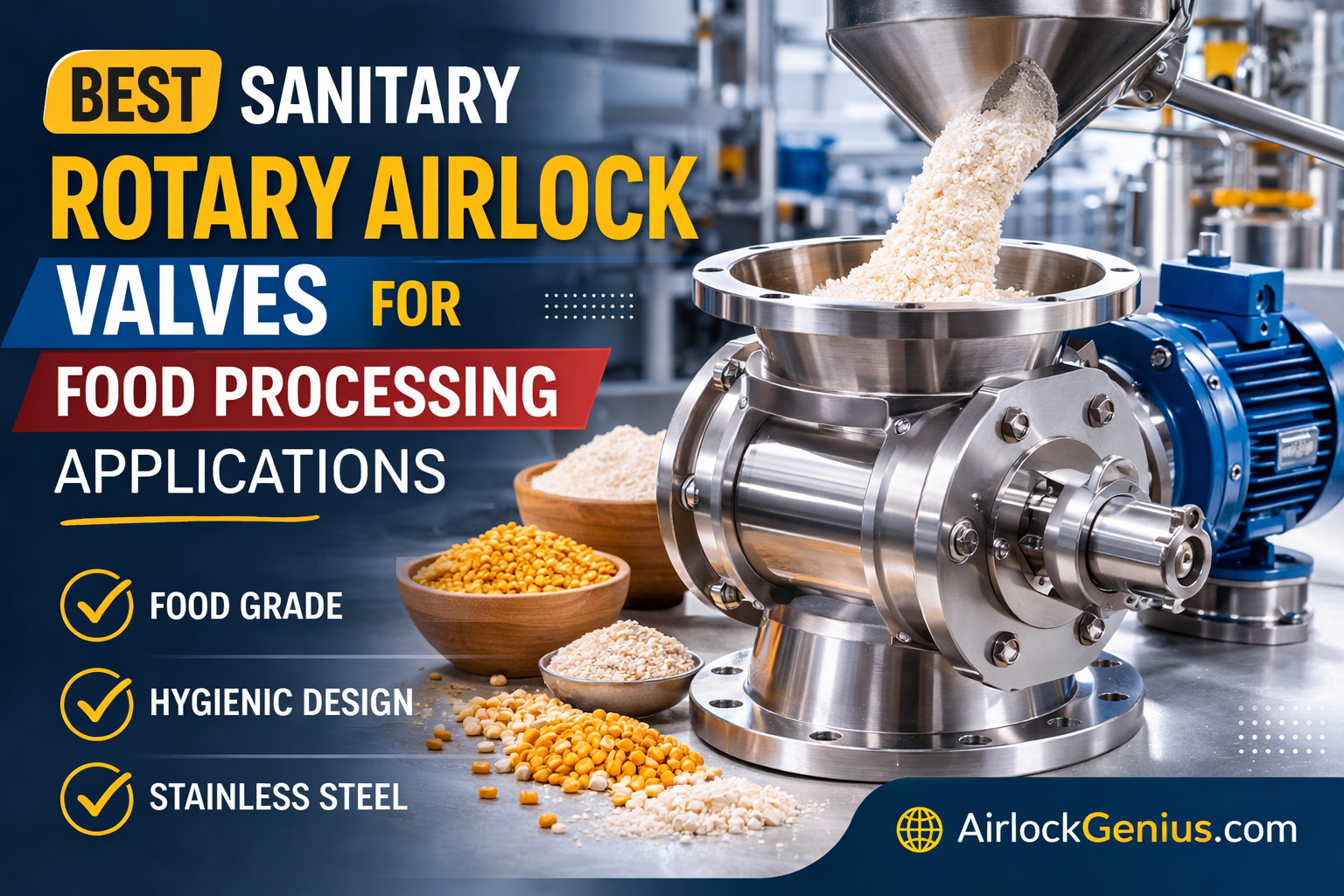
Best Sanitary Rotary Airlock Valves for Food Processing Applications

In the demanding world of food processing, where hygiene and product safety are non-negotiable, sanitary rotary airlock valves for food processing serve as essential components in material handling systems. These specialized valves control the flow of dry bulk materials like powders, granules, and ingredients while maintaining an airtight seal to prevent contamination and pressure loss. For facilities across the USA searching for reliable solutions, selecting the right sanitary rotary airlock valves for food processing can significantly improve efficiency, reduce downtime, and ensure compliance with strict regulations.

At Airlock Genius, we specialize in high-quality, Made-in-USA rotary airlock valves engineered for precision and durability in food applications. If you’re stuck choosing the best option for your operation, this guide highlights top features, benefits, and recommendations to help you decide.

Understanding Sanitary Rotary Airlock Valves

Sanitary rotary airlock valves for food processing are designed specifically for hygienic environments. Unlike standard valves, they feature smooth, crevice-free surfaces, often constructed from 304 or 316 stainless steel, to resist corrosion and support thorough cleaning. The rotor meters material from hoppers or conveyors into pneumatic systems while acting as an airlock to separate pressure zones.

These valves are critical in preventing cross-contamination, a major concern in food production. They comply with FDA and USDA guidelines, and many meet 3-A sanitary standards for dairy and other regulated products. Proper selection ensures seamless integration into your lines, whether handling flour, sugar, spices, or dairy powders.

For more on our tailored solutions, visit the food and beverage industry page or explore our full product range at Airlock Genius.

Why These Valves Matter in Food Processing

The importance of sanitary rotary airlock valves for food processing cannot be overstated. They maintain product purity by sealing out external contaminants and preventing material leakage that could lead to spoilage or recalls. In fast-paced USA facilities, quick-clean or clean-in-place (CIP) designs minimize downtime during sanitation cycles, boosting overall productivity.

Benefits include precise material metering for consistent batching, reduced dust escape for safer work environments, and enhanced compliance with food safety regulations. As noted in industry discussions, hygienic equipment like these valves helps avoid bacterial growth and supports long-term operational reliability in sensitive applications.

Essential Features to Prioritize

When evaluating sanitary rotary airlock valves for food processing, focus on:

  • Stainless steel construction (304/316) for corrosion resistance and easy sanitation.
  • Quick-clean mechanisms, such as rail systems for tool-less disassembly.
  • Smooth, polished interiors to prevent buildup and facilitate CIP.
  • High-pressure/temperature ratings suitable for your process.
  • Certifications like USDA-approved or FDA-compliant materials.

These features ensure the valve not only performs reliably but also aligns with rigorous USA food industry standards.

Top Recommendations for Food Processing

Here are some leading options based on performance, hygiene focus, and industry reputation:

  1. ACS Valves Sanitary CI Series — Features Quick-Clean RotorRail™ for fast, tool-less access and stainless steel build. Ideal for dairy and baking where frequent cleaning is required.
  2. Meyer Industrial KLEAN-IN-PLACE II® — Offers true in-place cleaning without full disassembly, emphasizing minimal downtime and superior hygiene for food and dairy lines.
  3. Rotolok Sanitary Rotary Airlock — USDA-approved design ensures contamination-free handling with durable stainless steel, perfect for regulated products.
  4. Prater Heavy Duty Series — Robust for abrasive or high-volume materials, with options for stainless construction to meet sanitary needs.
  5. Kice Sanitary CI Series — Incorporates RotorRail™ and run-clean technology for efficient, hygienic performance in demanding food environments.

For custom-engineered options that fit your exact specifications, Airlock Genius delivers precision solutions backed by decades of expertise.

Final Thoughts

Investing in the best sanitary rotary airlock valves for food processing directly impacts your facility’s safety, efficiency, and compliance. By prioritizing hygienic design, ease of maintenance, and proven reliability, you can avoid common pitfalls like contamination risks or excessive downtime.

If you’re ready to upgrade or need expert guidance for your USA-based operation, reach out to our team today. Contact us for personalized recommendations and support.

External Reference: For more on the role of hygienic equipment in maintaining food safety standards, see this overview from the U.S. Department of Agriculture on dairy processing equipment guidelines: USDA Guidelines for Sanitary Design.

Choosing the Ideal Airlock for Dust Collection Systems

Dust collection systems play a vital role in industrial environments. They capture airborne particles to ensure clean air and safe operations. At Airlock Genius, we specialize in providing reliable solutions for these systems. Airlocks are essential components that maintain system efficiency. They prevent air leakage while allowing dust to exit safely. Choosing the right one can make all the difference in performance.

In this guide, we’ll explore airlocks for dust collection. We’ll cover basics, key features, and selection tips. All based on our expertise at Airlock Genius.

Understanding Airlocks in Dust Collection

Airlocks, often called rotary valves, act as seals in dust collectors. They isolate the hopper from the atmosphere below. This maintains negative pressure inside the system. Without a proper airlock, dust can escape or backflow. This leads to inefficiencies and potential hazards. Our rotary airlocks at Airlock Genius are designed to handle these challenges effectively. Dust collection involves filtering particles from air streams. Airlocks discharge collected dust without disrupting the process. They ensure continuous operation in industries like chemicals and food processing.

Why Your Dust Collection System Needs an Airlock

Airlocks prevent system shutdowns for emptying bins. They allow safe dust transfer to containers or conveyors. This boosts productivity and reduces downtime. They maintain pressure differentials between zones. This is crucial for efficient filtration and air quality. Poor sealing can lead to energy waste and compliance issues. At Airlock Genius, our airlocks support various system sizes. Explore our rotary airlock valves for tailored solutions. They integrate seamlessly with dust collectors.

Key Characteristics of a High-Quality Rotary Airlock

A good airlock handles high volumes of dust efficiently. It minimizes wear and extends equipment life. Look for durable materials that resist abrasion. It should comply with safety standards like NFPA. This prevents explosion risks in combustible dust environments. Precision engineering ensures tight tolerances. Our products feature outboard bearings to avoid contamination. They also include beveled rotor tips for smooth operation. These details enhance reliability.

  • Material Compatibility: Choose airlocks suited to your dust type, whether abrasive or fine.
  • Size and Flange Options: Common sizes like 10″ or 12″ with square flanges fit most systems.
  • Motor Specifications: Explosion-proof motors are essential for hazardous areas.
  • Clearance Standards: Maintain under 0.0079″ for optimal sealing.

Designing for NFPA Compliance

NFPA standards are critical for explosion prevention. Codes like NFPA 69 and 68 guide airlock design. They ensure valves can withstand deflagration pressures. Compliant airlocks feature at least six vanes on rotors. This creates multiple seals to block flame propagation. Metal construction is mandatory for strength. Independent testing certifies pressure resistance. Valves must interlock with detection systems to stop during incidents. Always check local regulations.

  • NFPA 69 Key Rules:
    • Housing and rotor must endure maximum explosion pressure.
    • Account for dust’s Kst and Pmax values.
    • Use external bearings to prevent failures.
    • Include at least two vanes per side with proper clearances.

At Airlock Genius, our valves meet these standards. Learn more about our premium rotary solutions.

How to Select the Right Airlock for Your Needs

Selection depends on your system’s configuration. Consider dust volume, particle size, and temperature. Square flange models are popular for dust collectors. For general use, opt for heavy-duty cast iron airlocks. They handle bulk materials well. Size them appropriately to avoid bottlenecks. Our HDUCI series is ideal for dust applications. It offers robust performance and easy maintenance. Visit this product page for details.

  • Factors to Evaluate:
    • System pressure and vacuum levels.
    • Dust abrasiveness and moisture content.
    • Integration with existing equipment.
    • Budget and long-term ROI.

Optional Features to Enhance Performance

Enhance airlocks with high-temperature clearances. This accommodates thermal expansion in hot environments. It prevents jamming and wear. Shear protectors safeguard against overloads. They detect jams and protect drives. For abrasive dust, add chrome or tungsten plating. Variable speed drives allow metering control. This optimizes dust discharge rates. Airlock Genius offers customizations for these features.

  • Recommended Add-Ons:
    • AR rotors for extended durability.
    • Shear pin sprockets for quick recovery.
    • Seals for sanitary applications in the food industries.
    • Monitoring sensors for predictive maintenance.

Check our slide gate valves as complementary options.

Analyzing Your Dust for Optimal Safety

Dust properties influence airlock choice. Combustible dusts require explosion-proof designs. Test for Kst (deflagration index) and Pmax (maximum pressure). NFPA 652 mandates Dust Hazard Analysis (DHA). This identifies risks in your facility. Labs can classify dust as St1, St2, or St3. Unsure about your material? Consult experts or annexes in NFPA standards. Proper analysis prevents accidents and ensures compliance.

  • Dust Testing Steps:
    • Sample collection from your process.
    • Lab evaluation for explosibility.
    • Review of particle size and composition.
    • Integration into airlock specifications.

Our team at Airlock Genius can guide you. Read our blog on supply chain challenges for more insights.

Maintenance Tips for Long-Term Reliability

Regular maintenance keeps airlocks performing. Inspect rotor clearances quarterly. Replace worn parts promptly to avoid leaks. Clean internals to prevent buildup. Lubricate bearings as per guidelines. This extends service life and reduces costs. Conduct DHA every five years or after changes. Train staff on safe handling. These practices protect workers and assets.

  • Maintenance Checklist:
    • Check vane tips for wear.
    • Verify seal integrity.
    • Test motor and drive systems.
    • Document inspections for audits.

For parts, browse our products list.

Additional Protection Strategies

Beyond airlocks, use isolation devices. Flame arrestors and vents complement systems. They contain deflagrations effectively. Housekeeping minimizes dust accumulation. Ground equipment to prevent static sparks. These steps align with NFPA fundamentals. Partner with experts for system audits. Airlock Genius offers consultations. Our about page details our experience since 2005.

  • Safety Enhancements:
    • Install explosion suppression systems.
    • Use inerting where applicable.
    • Monitor air quality continuously.
    • Comply with OSHA regulations.

Getting Started with Airlock Genius Solutions

Ready to upgrade your dust collection? Assess your current setup first. Identify pain points like frequent jams or leaks. Contact us for custom recommendations. Our Made-in-USA products ensure quality. We serve industries from pharma to mining. Explore our full range today. From rotary valves to accessories, we have it all. Join our network via this link.

  • Next Steps:
    • Request a quote for your system.
    • Schedule a virtual consultation.
    • Review case studies on our site.
    • Stay updated with our blogs.

In summary, the right airlock transforms dust collection. It ensures efficiency, safety, and compliance. Trust Airlock Genius for expert solutions.

References

Lead Times, Supply Chain Challenges & Tariff Impact for Airlock Valves in the U.S.

Lead Times, Supply Chain Challenges & Tariff Impact for Airlock Valves in the U.S.


🔩 Current Lead TiIn today’s manufacturing climate, rotary airlock valves play a crucial role in dust collection, pneumatic conveying, and bulk material handling systems. But as of 2025, many U.S. buyers are facing longer lead times, increased pricing, and volatile supply chain disruptions—driven not just by logistics and labor shortages, but also by rising tariff pressures on imported components and raw materials.


🔩 Current Lead Times

Lead times for standard cast iron airlock valves now average 6 to 10 weeks, while more customized units (e.g., stainless steel, beveled rotors, air purge systems) can take 12–16 weeks or longer.

Key drivers include:

  • Custom rotor configurations (closed-end, scalloped, etc.)
  • Seal type (Teflon U-cup, cartridge, air purge)
  • Drive package availability (NORD, SEW-Eurodrive, Baldor)

⚠️ Supply Chain Challenges

1. Casting & Machining Delays

U.S. and offshore foundries remain behind on casting orders, especially for heavy, precision-machined parts. Limited capacity at CNC machining shops further increases backlogs.

2. Seal & Bearing Availability

Lead times on hybrid seal kits and specialty bearings (especially Teflon or FDA-grade) have doubled, with many U.S. suppliers relying on imports from Asia or Europe.

3. Gear Motor Bottlenecks

OEMs using NORD, SEW, or other brand gear motors report lead times from 6 to 10 weeks, especially for explosion-proof or custom flange-mounted units.

4. Labor & Freight Pressures

U.S. manufacturers face ongoing labor shortages in assembly and QA, and domestic freight delays add days—or weeks—depending on region and carrier capacity.


📉 Tariff Impact on Airlock Valve Pricing & Availability

Recent U.S. tariffs on steel, aluminum, and Chinese-manufactured industrial components have had a significant impact on airlock valves:

  • Imported motors, castings, and seals now carry higher costs due to Section 301 tariffs and anti-dumping duties.
  • Many U.S. airlock valve manufacturers source gear drives or sealing components from tariff-affected countries (e.g., China, Germany, India), raising material costs by 10–25%.
  • Some suppliers have shifted sourcing to alternative regions, but this comes with longer lead times and potential quality inconsistencies.
  • Buyers should expect price fluctuations every quarter and limited-time quotes, especially on international components.

Example: A rotary valve that used to cost $5,000 may now cost $5,750–$6,000 due to import duties, longer freight routes, and vendor surcharges.


🧠 What This Means for Buyers

If your operation depends on rotary airlock valves:

  • Place orders 3–4 months in advance, especially for shutdowns or capital projects.
  • Stock key spares like rotors, seals, and endplates.
  • Confirm with your vendor if the quote includes tariff surcharges or currency-related adjustments.
  • Consider Made-in-USA valve models or locally assembled options to reduce tariff exposure.

✅ Pro Tips to Mitigate Risks

  • Choose modular valve designs that use interchangeable parts.
  • Consolidate your BOMs to standardize motor and seal specs.
  • Build long-term partnerships with domestic suppliers who carry inventory or offer drop-in replacements.
  • Request locked pricing when issuing blanket POs for the year.

🧭 Conclusion

In 2025, the market for rotary airlock valves is shaped by more than just engineering specs—tariffs, freight delays, labor shortages, and component sourcing now all impact lead time, cost, and availability. To stay ahead, procurement and maintenance teams must plan early, standardize smartly, and build strong supplier relationships.mes

Lead times for standard cast iron airlock valves now average 6 to 10 weeks, while more customized units (e.g., stainless steel, beveled rotors, air purge systems) can take 12–16 weeks or longer.

Key drivers include:

  • Custom rotor configurations (closed-end, scalloped, etc.)
  • Seal type (Teflon U-cup, cartridge, air purge)
  • Drive package availability (NORD, SEW-Eurodrive, Baldor)

⚠️ Supply Chain Challenges

1. Casting & Machining Delays

U.S. and offshore foundries remain behind on casting orders, especially for heavy, precision-machined parts. Limited capacity at CNC machining shops further increases backlogs.

2. Seal & Bearing Availability

Lead times on hybrid seal kits and specialty bearings (especially Teflon or FDA-grade) have doubled, with many U.S. suppliers relying on imports from Asia or Europe.

3. Gear Motor Bottlenecks

OEMs using NORD, SEW, or other brand gear motors report lead times from 6 to 10 weeks, especially for explosion-proof or custom flange-mounted units.

4. Labor & Freight Pressures

U.S. manufacturers face ongoing labor shortages in assembly and QA, and domestic freight delays add days—or weeks—depending on region and carrier capacity.


📉 Tariff Impact on Airlock Valve Pricing & Availability

Recent U.S. tariffs on steel, aluminum, and Chinese-manufactured industrial components have had a significant impact on airlock valves:

  • Imported motors, castings, and seals now carry higher costs due to Section 301 tariffs and anti-dumping duties.
  • Many U.S. airlock valve manufacturers source gear drives or sealing components from tariff-affected countries (e.g., China, Germany, India), raising material costs by 10–25%.
  • Some suppliers have shifted sourcing to alternative regions, but this comes with longer lead times and potential quality inconsistencies.
  • Buyers should expect price fluctuations every quarter and limited-time quotes, especially on international components.

Example: A rotary valve that used to cost $5,000 may now cost $5,750–$6,000 due to import duties, longer freight routes, and vendor surcharges.


🧠 What This Means for Buyers

If your operation depends on rotary airlock valves:

  • Place orders 3–4 months in advance, especially for shutdowns or capital projects.
  • Stock key spares like rotors, seals, and endplates.
  • Confirm with your vendor if the quote includes tariff surcharges or currency-related adjustments.
  • Consider Made-in-USA valve models or locally assembled options to reduce tariff exposure.

✅ Pro Tips to Mitigate Risks

  • Choose modular valve designs that use interchangeable parts.
  • Consolidate your BOMs to standardize motor and seal specs.
  • Build long-term partnerships with domestic suppliers who carry inventory or offer drop-in replacements.
  • Request locked pricing when issuing blanket POs for the year.

🧭 Conclusion

In 2025, the market for rotary airlock valves is shaped by more than just engineering specs—tariffs, freight delays, labor shortages, and component sourcing all affect lead time, cost, and availability. To stay ahead, procurement and maintenance teams must plan early, standardize smartly, and build strong supplier relationships.

At Airlock Genius, we understand these challenges and proactively maintain an in-stock inventory of hundreds of airlock valves. This ensures faster turnaround times and helps our customers avoid costly delays—whether for planned projects or urgent replacements.