
Choosing the Ideal Airlock for Dust Collection Systems

Dust collection systems play a vital role in industrial environments. They capture airborne particles to ensure clean air and safe operations. At Airlock Genius, we specialize in providing reliable solutions for these systems. Airlocks are essential components that maintain system efficiency. They prevent air leakage while allowing dust to exit safely. Choosing the right one can make all the difference in performance.

In this guide, we’ll explore airlocks for dust collection. We’ll cover basics, key features, and selection tips. All based on our expertise at Airlock Genius.

Understanding Airlocks in Dust Collection

Airlocks, often called rotary valves, act as seals in dust collectors. They isolate the hopper from the atmosphere below. This maintains negative pressure inside the system. Without a proper airlock, dust can escape or backflow. This leads to inefficiencies and potential hazards. Our rotary airlocks at Airlock Genius are designed to handle these challenges effectively. Dust collection involves filtering particles from air streams. Airlocks discharge collected dust without disrupting the process. They ensure continuous operation in industries like chemicals and food processing.

Why Your Dust Collection System Needs an Airlock

Airlocks prevent system shutdowns for emptying bins. They allow safe dust transfer to containers or conveyors. This boosts productivity and reduces downtime. They maintain pressure differentials between zones. This is crucial for efficient filtration and air quality. Poor sealing can lead to energy waste and compliance issues. At Airlock Genius, our airlocks support various system sizes. Explore our rotary airlock valves for tailored solutions. They integrate seamlessly with dust collectors.

Key Characteristics of a High-Quality Rotary Airlock

A good airlock handles high volumes of dust efficiently. It minimizes wear and extends equipment life. Look for durable materials that resist abrasion. It should comply with safety standards like NFPA. This prevents explosion risks in combustible dust environments. Precision engineering ensures tight tolerances. Our products feature outboard bearings to avoid contamination. They also include beveled rotor tips for smooth operation. These details enhance reliability.

  • Material Compatibility: Choose airlocks suited to your dust type, whether abrasive or fine.
  • Size and Flange Options: Common sizes like 10″ or 12″ with square flanges fit most systems.
  • Motor Specifications: Explosion-proof motors are essential for hazardous areas.
  • Clearance Standards: Maintain under 0.0079″ for optimal sealing.

Designing for NFPA Compliance

NFPA standards are critical for explosion prevention. Codes like NFPA 69 and 68 guide airlock design. They ensure valves can withstand deflagration pressures. Compliant airlocks feature at least six vanes on rotors. This creates multiple seals to block flame propagation. Metal construction is mandatory for strength. Independent testing certifies pressure resistance. Valves must interlock with detection systems to stop during incidents. Always check local regulations.

  • NFPA 69 Key Rules:
    • Housing and rotor must endure maximum explosion pressure.
    • Account for dust’s Kst and Pmax values.
    • Use external bearings to prevent failures.
    • Include at least two vanes per side with proper clearances.

At Airlock Genius, our valves meet these standards. Learn more about our premium rotary solutions.

How to Select the Right Airlock for Your Needs

Selection depends on your system’s configuration. Consider dust volume, particle size, and temperature. Square flange models are popular for dust collectors. For general use, opt for heavy-duty cast iron airlocks. They handle bulk materials well. Size them appropriately to avoid bottlenecks. Our HDUCI series is ideal for dust applications. It offers robust performance and easy maintenance. Visit this product page for details.

  • Factors to Evaluate:
    • System pressure and vacuum levels.
    • Dust abrasiveness and moisture content.
    • Integration with existing equipment.
    • Budget and long-term ROI.

Optional Features to Enhance Performance

Enhance airlocks with high-temperature clearances. This accommodates thermal expansion in hot environments. It prevents jamming and wear. Shear protectors safeguard against overloads. They detect jams and protect drives. For abrasive dust, add chrome or tungsten plating. Variable speed drives allow metering control. This optimizes dust discharge rates. Airlock Genius offers customizations for these features.

  • Recommended Add-Ons:
    • AR rotors for extended durability.
    • Shear pin sprockets for quick recovery.
    • Seals for sanitary applications in the food industries.
    • Monitoring sensors for predictive maintenance.

Check our slide gate valves as complementary options.

Analyzing Your Dust for Optimal Safety

Dust properties influence airlock choice. Combustible dusts require explosion-proof designs. Test for Kst (deflagration index) and Pmax (maximum pressure). NFPA 652 mandates Dust Hazard Analysis (DHA). This identifies risks in your facility. Labs can classify dust as St1, St2, or St3. Unsure about your material? Consult experts or annexes in NFPA standards. Proper analysis prevents accidents and ensures compliance.

  • Dust Testing Steps:
    • Sample collection from your process.
    • Lab evaluation for explosibility.
    • Review of particle size and composition.
    • Integration into airlock specifications.

Our team at Airlock Genius can guide you. Read our blog on supply chain challenges for more insights.

Maintenance Tips for Long-Term Reliability

Regular maintenance keeps airlocks performing. Inspect rotor clearances quarterly. Replace worn parts promptly to avoid leaks. Clean internals to prevent buildup. Lubricate bearings as per guidelines. This extends service life and reduces costs. Conduct DHA every five years or after changes. Train staff on safe handling. These practices protect workers and assets.

  • Maintenance Checklist:
    • Check vane tips for wear.
    • Verify seal integrity.
    • Test motor and drive systems.
    • Document inspections for audits.

For parts, browse our products list.

Additional Protection Strategies

Beyond airlocks, use isolation devices. Flame arrestors and vents complement systems. They contain deflagrations effectively. Housekeeping minimizes dust accumulation. Ground equipment to prevent static sparks. These steps align with NFPA fundamentals. Partner with experts for system audits. Airlock Genius offers consultations. Our about page details our experience since 2005.

  • Safety Enhancements:
    • Install explosion suppression systems.
    • Use inerting where applicable.
    • Monitor air quality continuously.
    • Comply with OSHA regulations.

Getting Started with Airlock Genius Solutions

Ready to upgrade your dust collection? Assess your current setup first. Identify pain points like frequent jams or leaks. Contact us for custom recommendations. Our Made-in-USA products ensure quality. We serve industries from pharma to mining. Explore our full range today. From rotary valves to accessories, we have it all. Join our network via this link.

  • Next Steps:
    • Request a quote for your system.
    • Schedule a virtual consultation.
    • Review case studies on our site.
    • Stay updated with our blogs.

In summary, the right airlock transforms dust collection. It ensures efficiency, safety, and compliance. Trust Airlock Genius for expert solutions.

References

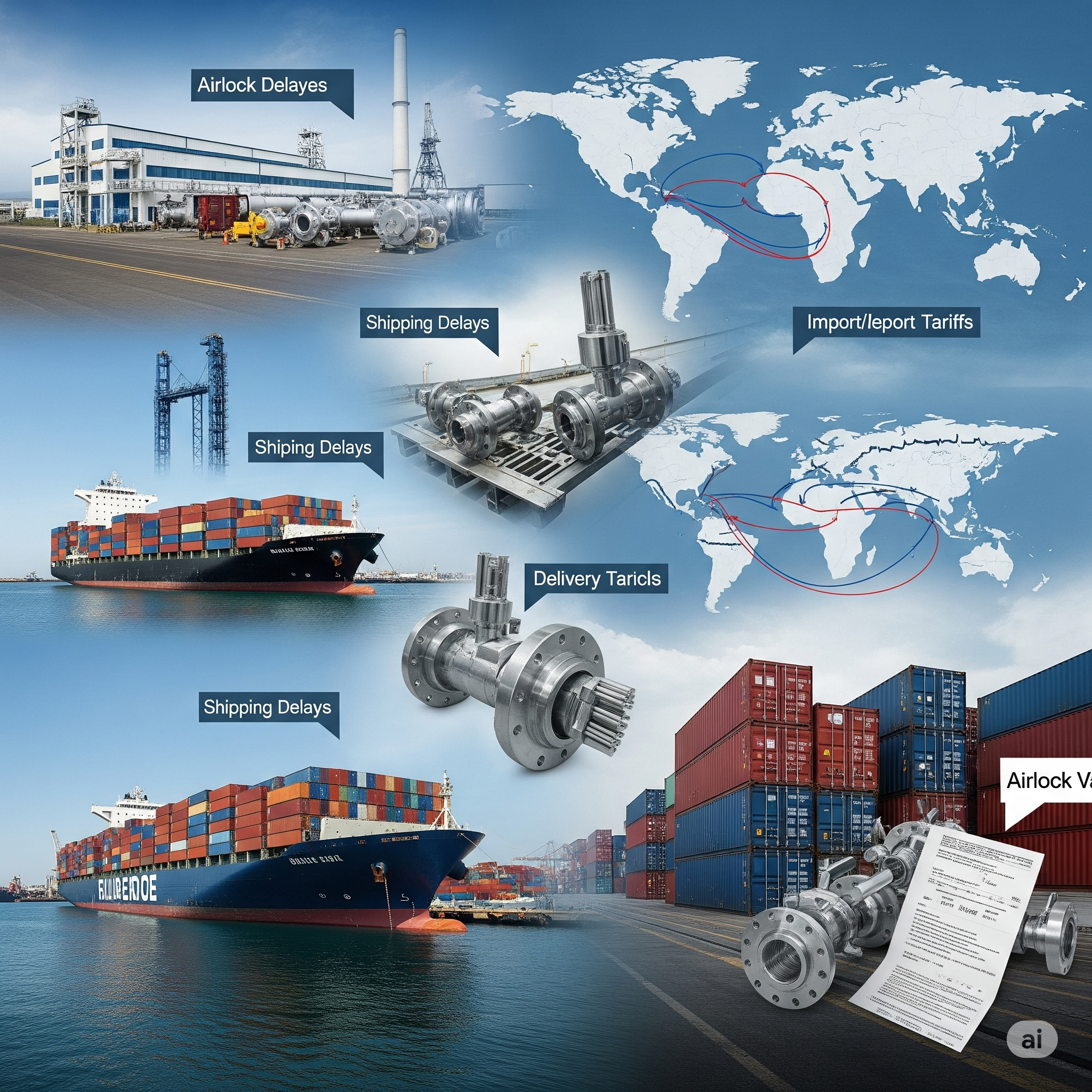
Lead Times, Supply Chain Challenges & Tariff Impact for Airlock Valves in the U.S.

Lead Times, Supply Chain Challenges & Tariff Impact for Airlock Valves in the U.S.


🔩 Current Lead TiIn today’s manufacturing climate, rotary airlock valves play a crucial role in dust collection, pneumatic conveying, and bulk material handling systems. But as of 2025, many U.S. buyers are facing longer lead times, increased pricing, and volatile supply chain disruptions—driven not just by logistics and labor shortages, but also by rising tariff pressures on imported components and raw materials.


🔩 Current Lead Times

Lead times for standard cast iron airlock valves now average 6 to 10 weeks, while more customized units (e.g., stainless steel, beveled rotors, air purge systems) can take 12–16 weeks or longer.

Key drivers include:

  • Custom rotor configurations (closed-end, scalloped, etc.)
  • Seal type (Teflon U-cup, cartridge, air purge)
  • Drive package availability (NORD, SEW-Eurodrive, Baldor)

⚠️ Supply Chain Challenges

1. Casting & Machining Delays

U.S. and offshore foundries remain behind on casting orders, especially for heavy, precision-machined parts. Limited capacity at CNC machining shops further increases backlogs.

2. Seal & Bearing Availability

Lead times on hybrid seal kits and specialty bearings (especially Teflon or FDA-grade) have doubled, with many U.S. suppliers relying on imports from Asia or Europe.

3. Gear Motor Bottlenecks

OEMs using NORD, SEW, or other brand gear motors report lead times from 6 to 10 weeks, especially for explosion-proof or custom flange-mounted units.

4. Labor & Freight Pressures

U.S. manufacturers face ongoing labor shortages in assembly and QA, and domestic freight delays add days—or weeks—depending on region and carrier capacity.


📉 Tariff Impact on Airlock Valve Pricing & Availability

Recent U.S. tariffs on steel, aluminum, and Chinese-manufactured industrial components have had a significant impact on airlock valves:

  • Imported motors, castings, and seals now carry higher costs due to Section 301 tariffs and anti-dumping duties.
  • Many U.S. airlock valve manufacturers source gear drives or sealing components from tariff-affected countries (e.g., China, Germany, India), raising material costs by 10–25%.
  • Some suppliers have shifted sourcing to alternative regions, but this comes with longer lead times and potential quality inconsistencies.
  • Buyers should expect price fluctuations every quarter and limited-time quotes, especially on international components.

Example: A rotary valve that used to cost $5,000 may now cost $5,750–$6,000 due to import duties, longer freight routes, and vendor surcharges.


🧠 What This Means for Buyers

If your operation depends on rotary airlock valves:

  • Place orders 3–4 months in advance, especially for shutdowns or capital projects.
  • Stock key spares like rotors, seals, and endplates.
  • Confirm with your vendor if the quote includes tariff surcharges or currency-related adjustments.
  • Consider Made-in-USA valve models or locally assembled options to reduce tariff exposure.

✅ Pro Tips to Mitigate Risks

  • Choose modular valve designs that use interchangeable parts.
  • Consolidate your BOMs to standardize motor and seal specs.
  • Build long-term partnerships with domestic suppliers who carry inventory or offer drop-in replacements.
  • Request locked pricing when issuing blanket POs for the year.

🧭 Conclusion

In 2025, the market for rotary airlock valves is shaped by more than just engineering specs—tariffs, freight delays, labor shortages, and component sourcing now all impact lead time, cost, and availability. To stay ahead, procurement and maintenance teams must plan early, standardize smartly, and build strong supplier relationships.mes

Lead times for standard cast iron airlock valves now average 6 to 10 weeks, while more customized units (e.g., stainless steel, beveled rotors, air purge systems) can take 12–16 weeks or longer.

Key drivers include:

  • Custom rotor configurations (closed-end, scalloped, etc.)
  • Seal type (Teflon U-cup, cartridge, air purge)
  • Drive package availability (NORD, SEW-Eurodrive, Baldor)

⚠️ Supply Chain Challenges

1. Casting & Machining Delays

U.S. and offshore foundries remain behind on casting orders, especially for heavy, precision-machined parts. Limited capacity at CNC machining shops further increases backlogs.

2. Seal & Bearing Availability

Lead times on hybrid seal kits and specialty bearings (especially Teflon or FDA-grade) have doubled, with many U.S. suppliers relying on imports from Asia or Europe.

3. Gear Motor Bottlenecks

OEMs using NORD, SEW, or other brand gear motors report lead times from 6 to 10 weeks, especially for explosion-proof or custom flange-mounted units.

4. Labor & Freight Pressures

U.S. manufacturers face ongoing labor shortages in assembly and QA, and domestic freight delays add days—or weeks—depending on region and carrier capacity.


📉 Tariff Impact on Airlock Valve Pricing & Availability

Recent U.S. tariffs on steel, aluminum, and Chinese-manufactured industrial components have had a significant impact on airlock valves:

  • Imported motors, castings, and seals now carry higher costs due to Section 301 tariffs and anti-dumping duties.
  • Many U.S. airlock valve manufacturers source gear drives or sealing components from tariff-affected countries (e.g., China, Germany, India), raising material costs by 10–25%.
  • Some suppliers have shifted sourcing to alternative regions, but this comes with longer lead times and potential quality inconsistencies.
  • Buyers should expect price fluctuations every quarter and limited-time quotes, especially on international components.

Example: A rotary valve that used to cost $5,000 may now cost $5,750–$6,000 due to import duties, longer freight routes, and vendor surcharges.


🧠 What This Means for Buyers

If your operation depends on rotary airlock valves:

  • Place orders 3–4 months in advance, especially for shutdowns or capital projects.
  • Stock key spares like rotors, seals, and endplates.
  • Confirm with your vendor if the quote includes tariff surcharges or currency-related adjustments.
  • Consider Made-in-USA valve models or locally assembled options to reduce tariff exposure.

✅ Pro Tips to Mitigate Risks

  • Choose modular valve designs that use interchangeable parts.
  • Consolidate your BOMs to standardize motor and seal specs.
  • Build long-term partnerships with domestic suppliers who carry inventory or offer drop-in replacements.
  • Request locked pricing when issuing blanket POs for the year.

🧭 Conclusion

In 2025, the market for rotary airlock valves is shaped by more than just engineering specs—tariffs, freight delays, labor shortages, and component sourcing all affect lead time, cost, and availability. To stay ahead, procurement and maintenance teams must plan early, standardize smartly, and build strong supplier relationships.

At Airlock Genius, we understand these challenges and proactively maintain an in-stock inventory of hundreds of airlock valves. This ensures faster turnaround times and helps our customers avoid costly delays—whether for planned projects or urgent replacements.

“Can U.S. Manufacturing Keep Up? The Real Cost of Tariffs in 2025”

“Can U.S. Manufacturing Keep Up? The Real Cost of Tariffs in 2025”


Here’s an updated overview on how U.S. manufacturing capacity is holding up amid tariffs—and how it’s affecting prices:


🏭 1. Manufacturing capacity & activity

  • Overall weak performance: The Institute for Supply Management’s PMI has been below 50 for four straight months, signaling contraction in manufacturing, with June at 49.0 (Reuters).
  • Mixed sector trends: While nine industries showed growth in June, six contracted. Uncertainty around tariffs and lack of clarity post–July 9 slowed long-term planning (Al Jazeera).
  • Labor & investment shifts: Many firms are scaling back hiring, increasing automation, and reassessing global supply chains .

⚙️ 2. Tariff impacts on inputs & capacity

  • Raw materials surge: Steel, aluminum, and copper tariffs (now up to 50%) boosted input costs significantly. BCG estimates the metals tariff alone adds $50 billion to costs (BCG Global).
  • Copper volatility: Copper futures spiked ~13% after the 50% tariff announcement, with only two U.S. smelters available—insufficient to meet demand (The Times).
  • Domestic capacity constraints: Despite the intent to boost local production, rebuilding U.S. smelting and fabrication capacity is a long-term challenge—not a short-run fix .

💵 3. Pricing and cost pass-through

  • Higher consumer prices: Yale Budget Lab estimates tariffs through early July cause a 1.8–1.9% bump in consumer prices, translating to ~$2,000–$2,500 household income loss this year (The Budget Lab at Yale).
  • Industry pass-through: Materials-intensive goods like vehicles, textiles, leather, and apparel saw prices rise sharply—e.g., new-car prices +13.5% in the near term; +10.5% longer term .
  • Domestic inflation spillover: Even U.S.-made products are more expensive due to higher input costs and supply chain disruptions.

🚗 4. Sector-specific repercussions

SectorImpact
Auto & electronicsAutomakers like Ford and Toyota raised consumer prices as copper/steel costs inflated; material content doubling could add ~$5,700 per imported vehicle (Reuters).
Construction & appliancesSteel/aluminum tariff hikes disrupt supply chains, likely increasing costs by thousands per appliance or vehicle and straining firms like Independent Can and Heritage Steel .
Fashion & textilesLeather/footwear +39%, apparel +37% short‑run; ~18% price rises estimated long‑term .

🔭 5. Capacity outlook & strategic response

  • Limited domestic capacity expansion: Rebuilding steel, aluminum, and copper facilities takes years and significant investment—not rapidly done .
  • Mixed domestic benefit: Some manufacturers (e.g., Jergens Inc.) saw a 10–15% boost in demand due to reshoring, but the impact is uneven (The Australian). High-end and tech sectors continue to struggle .
  • Supply chain adaptation: Firms are pivoting—diversifying sourcing, automating production, renegotiating with suppliers, and using tariff mitigation tactics .

✅ Summary

  1. Capacity remains constrained: U.S. firms can’t swiftly scale up raw-material production; existing capacity is insufficient.
  2. Costs are being passed on: Consumers are already paying more across multiple sectors due to higher tariffs.
  3. Temporary domestic gains: Some manufacturers benefit, but broader capacity expansion is gradual and fragile.
  4. Recession risks: Higher prices, slowed investment, and economic reallocation put pressure on GDP growth and employment.

In short, U.S. manufacturing capacity is struggling to keep pace with tariff-driven disruptions, leading to material shortages, higher production costs, and widespread price increases—particularly in steel-, copper-, and aluminum-intensive sectors. While some reshoring gains are emerging, full-scale domestic production ramp-up remains a long-term effort.