
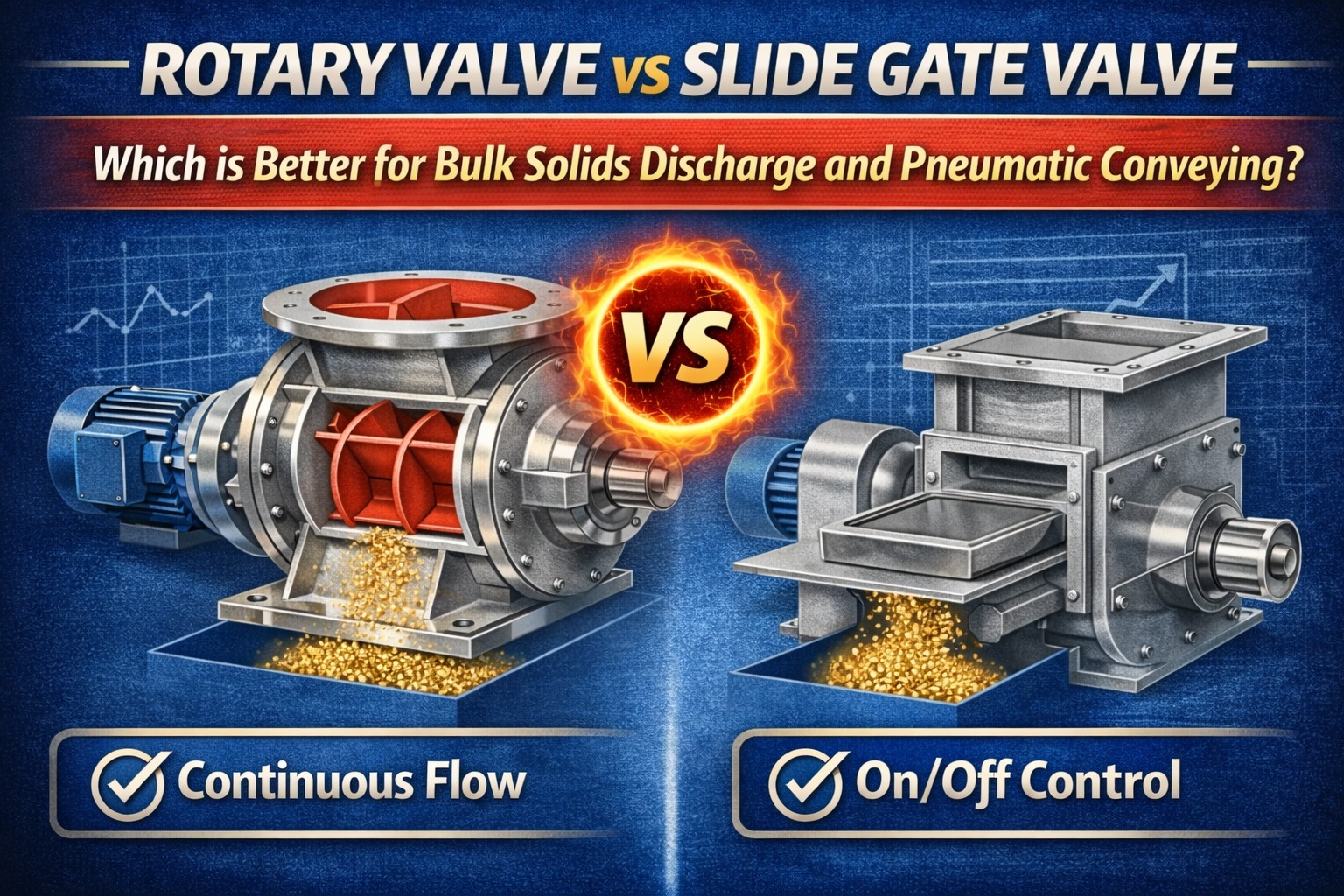
Choosing the right valve for bulk solids discharge and pneumatic conveying has a direct influence on system efficiency, consistency of material flow, air leakage control, and overall costs of operation. If your facility is handling powders, granules, or pellets such as food processing plants in Georgia, pharmaceutical production, or chemical bulk handling all over the USA, your decision between a rotary valve (sometimes referred to as rotary airlock valve) and a slide gate valve (also known as slide gate or knife gate) will be based on your particular application requirements.
A rotary valve uses a rotating rotor with pockets to meter material continuously while maintaining a pressure seal between upstream and downstream zones. This makes it ideal for applications requiring consistent feed rates and airlock functionality. A slide gate valve employs a flat sliding plate to open, close, or partially regulate flow, excelling in on/off isolation or simple gravity discharge with minimal moving parts.
Both valves serve critical roles in dust collection hoppers, silo discharge, and pneumatic conveying lines, but neither is universally “better.” Rotary valves shine in continuous metering under pressure differentials, while slide gate valves provide reliable shutoff and lower maintenance in gravity or low-pressure scenarios. At Airlock Genius, a trusted USA-based manufacturer with in-house engineering expertise, we produce precision rotary valves in 304/316 stainless steel for demanding bulk handling. This comparison helps you decide which suits your process.
Key Design and Functional Differences
Rotary Valve (Rotary Airlock Valve)
- Continuous rotation meters material at controlled rates.
- Maintains partial airlock/seal against pressure differentials (typically up to 15–22 PSIG in heavy-duty models).
- Drop-through for gravity discharge; blow-through for direct pneumatic conveying integration.
- 8–10 vane rotors reduce leakage and improve metering accuracy.
Slide Gate Valve
- Linear sliding plate provides full open/close or throttling.
- Excellent for isolation, shutoff through material piles, or flow regulation in gravity systems.
- Low-profile, minimal obstruction to flow when open.
- Often used in dilute/dense phase conveying for line isolation or above rotary valves to reduce leakage.
Advantages and Best Applications
When Rotary Valve is Better
Rotary valves excel in scenarios requiring continuous, metered discharge and pressure management:
- Pneumatic conveying systems (dilute or dense phase) where consistent feed into pressurized lines is essential.
- Dust collector hopper discharge under vacuum or slight pressure to prevent air infiltration and maintain system efficiency.
- Applications needing precise volumetric control, such as feeding extruders, mixers, or scales.
- Combustible dust environments—tight clearances and multiple vanes help meet NFPA 660 standards for isolation and flame propagation prevention.
They handle free-flowing to moderately cohesive materials like flour, sugar, chemicals, or minerals with reliable performance.
When Slide Gate Valve is Better
Slide gate valves outperform in isolation, simplicity, and low-maintenance needs:
- Gravity-fed discharge from silos, bins, or hoppers where on/off control or partial flow regulation suffices.
- Shutoff above rotary valves in pneumatic conveying to minimize air leakage when not operating or during maintenance.
- Abrasive or large-particle materials that could jam rotors—slide gates close through flowing material without damage.
- Budget-conscious setups or systems with infrequent operation, as they have fewer moving parts and no drive motor.
They suit isolation in multi-line conveying, maintenance gates, or clear-action barriers to enhance overall system efficiency.
Performance Comparison: Discharge and Conveying Efficiency
- Metering and Flow Control — Rotary valves provide superior continuous, volumetric metering; slide gates offer basic throttling but less precision.
- Air Leakage and Pressure Handling — Rotary valves manage differentials better inherently; slide gates provide excellent seals when closed but no continuous airlock.
- Maintenance and Downtime — Slide gates require less upkeep (no bearings/rotors to wear); rotary valves need periodic clearance checks and lubrication.
- Material Compatibility — Both handle dry bulk solids, but rotary valves risk jamming with sticky/abrasive materials unless equipped with adjustable tips; slide gates cut through piles reliably.
- Cost and Energy — Slide gates are lower initial cost and energy use (manual or actuated); rotary valves consume power for continuous rotation.
Many systems combine both: a slide gate above a rotary valve for isolation and leakage reduction in pneumatic conveying.
Conclusion
Neither a rotary valve nor a slide gate valve is universally superior—the best choice depends on your priorities. For continuous metering, pressure sealing, and pneumatic conveying feed, a rotary valve delivers unmatched performance and reliability. For simple isolation, gravity discharge, or augmenting rotary systems with better shutoff, a slide gate valve often proves more efficient and cost-effective.
In dust collection, bulk discharge, or conveying setups, evaluate material properties, pressure needs, flow requirements, and maintenance access. Proper selection prevents issues like backups, excessive leakage, or premature wear while ensuring compliance and uptime.
Airlock Genius specializes in USA-made rotary valves engineered for precision and durability in food, pharma, chemical, and bulk handling applications. Discover our rotary valve solutions tailored to your process.
Unsure which valve fits your bulk solids discharge or pneumatic conveying system? Contact our team for a free consultation on rotary valve vs slide gate valve options. Our experts will help optimize your setup for maximum efficiency and reliability.
Frequently Asked Questions
Can a slide gate valve replace a rotary valve in pneumatic conveying?
No—slide gates lack continuous metering and airlock capability; they’re better for isolation, often used in combination with rotary valves.
Which valve handles combustible dust better for NFPA compliance?
Rotary valves with tight clearances and multiple vanes provide effective isolation per NFPA 660; slide gates excel at positive shutoff but don’t meter continuously.
What if my material is abrasive or sticky?
Slide gates handle abrasion well with durable plates; rotary valves may require hardened tips or lower speeds to minimize wear.
Do rotary valves consume more energy than slide gates?
Yes—continuous rotation requires motor power, while slide gates use energy only during actuation.