
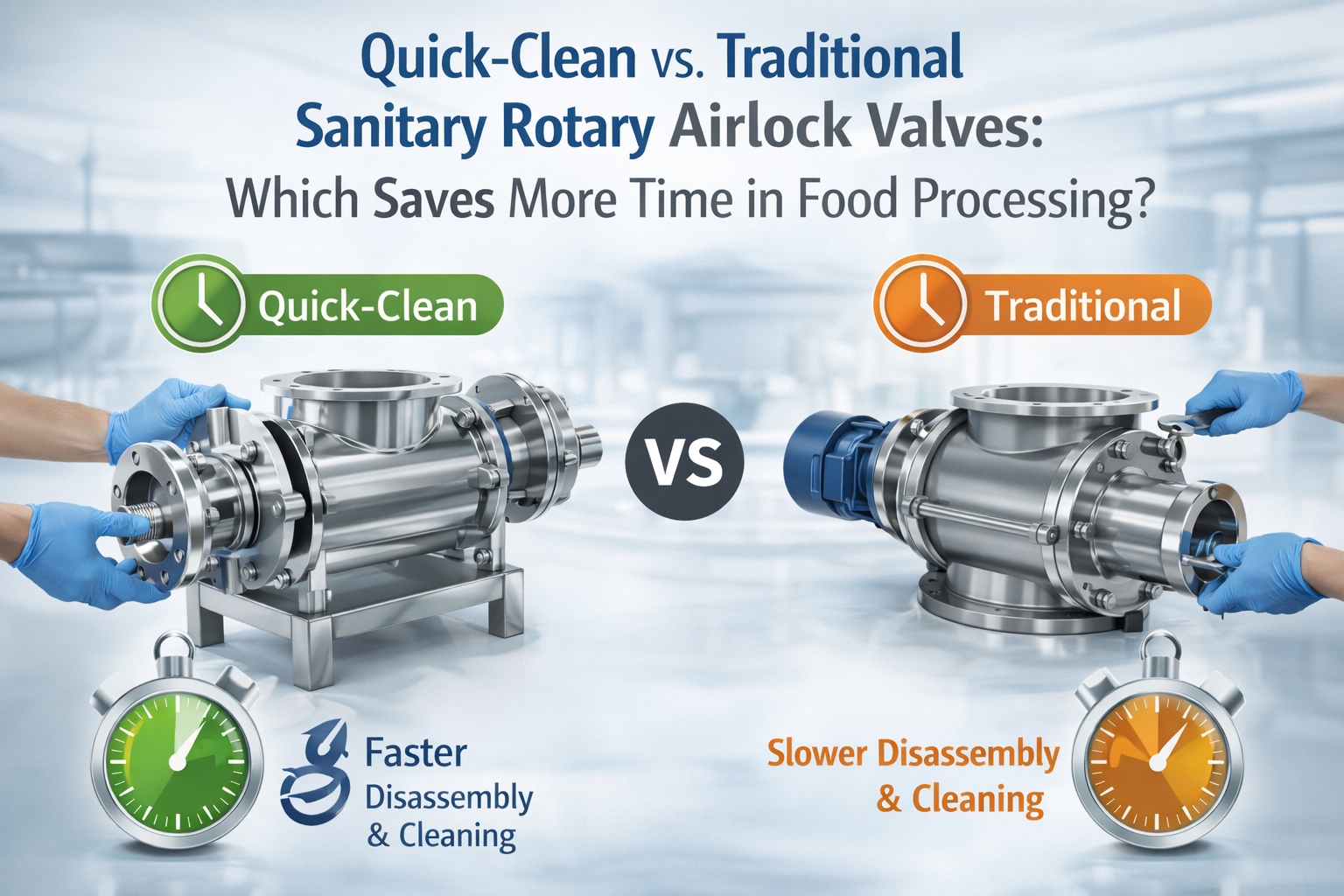
From the flour and sugar handling areas of bakeries in Georgia to the dairies in the Midwest, sanitary rotary airlock valves are a critical component in maintaining the cleanliness standards, preventing cross-contamination, and providing continuous bulk material flow in pneumatic conveying and dust collection systems in food processing plants throughout the United States. Sanitary rotary airlock valves must not only meet the stringent FDA, USDA, and sanitary standards, but they also have to be capable of minimum downtime during the frequent cleaning for product changeovers or daily sanitation.
Usually, sanitary rotary airlock valves that are quite common in the industry often drop-through or fixed designs made of 304/316 stainless steel have been reliable for years. However, they require quite a long disassembly time and as a result tools rotor removal, and exact re-alignment to maintain tight clearances and avoid leaks or contamination risks are needed.
Quick-clean sanitary rotary airlock valves, incorporating features like rail systems or tool-less access, help to tackle these issues directly. Made for very clean environments, they allow faster inspection, cleaning, and reassembling without sacrificing efficiency or compliance.
Airlock Genius, a dependable USA manufacturer with engineering experience in house, is the one to turn to for highly accurate sanitary rotary airlock valves made of stainless steel, including quick-clean versions that focus on saving time and increasing efficiency. This comparison looks at which type of design really leads to more time savings in actual food processing operations.
Key Differences in Design and Cleaning Process
Traditional Sanitary Rotary Airlock Valves
These sanitary rotary airlock valves typically feature bolted endplates and fixed rotors. Cleaning requires:
- Full system shutdown and lockout/tagout
- Disassembly of multiple bolts and connections
- Careful rotor extraction to prevent damage or misalignment
- Manual cleaning of housing interiors and pockets
- Re-gapping and reassembly with torque specifications
This process often takes 1–2 hours or more per valve, especially in larger sizes or when validating cleanliness for allergen control or regulatory audits. Downtime accumulates quickly in multi-shift operations with frequent product switches.
Quick-Clean Sanitary Rotary Airlock Valves
Quick-clean models incorporate features like RotorRail™-style systems, quick-release clamps, or hinged designs for tool-less access. Operators can:
- Slide the rotor out on integrated rails without disconnecting convey lines
- Gain full access to housing interiors and rotor pockets
- Perform thorough washdown or wipe-down in minutes
- Reassemble precisely without re-measuring clearances
Many designs allow disassembly, cleaning, and reassembly in 20–30 minutes—or as little as 2 minutes for basic access in some advanced models. This dramatic reduction stems from eliminating complex re-alignment steps and reducing labor needs.
Time Savings and Downtime Impact
The primary advantage of quick-clean sanitary rotary airlock valves lies in reduced cleaning time. Industry examples show traditional valves requiring 90+ minutes for full sanitation, while quick-clean versions cut this to 20 minutes or less—a savings of 70+ minutes per cleaning cycle.
At a conservative $500 per hour downtime cost (common in food processing for lost production and labor), cleaning one traditional valve costs around $750 in lost productivity. The same cycle with a quick-clean design drops to about $167, delivering over $580 in savings per event. For facilities cleaning multiple valves weekly, annual savings reach tens of thousands.
Beyond direct time, quick-clean designs reduce operator fatigue and injury risk during heavy lifting or awkward disassembly. They also support faster product changeovers—critical in allergen-sensitive lines—and improve audit readiness with easier validation of clean surfaces.
When Each Type Makes Sense
Traditional sanitary rotary airlock valves remain suitable for:
- Low-frequency cleaning applications
- Budget-constrained installations with stable product runs
- Systems where space limits rail additions
Quick-clean sanitary rotary airlock valves excel in:
- High-sanitation environments (dairy, baking, nutraceuticals)
- Facilities with daily or multi-shift cleanings
- Operations prioritizing uptime and regulatory compliance
Many processors upgrade to quick-clean models during expansions or retrofits to capture immediate ROI through reduced downtime.
Conclusion
For most modern food processing operations, quick-clean sanitary rotary airlock valves save significantly more time than traditional designs. The ability to perform fast, tool-less cleaning and reassembly translates to less downtime, lower labor costs, improved safety, and better compliance with hygiene standards—all while maintaining the reliable airlock performance needed for efficient material handling.
While traditional sanitary rotary airlock valves offer dependable service in simpler setups, the time and cost advantages of quick-clean technology make them the smarter long-term choice for high-output, sanitation-focused facilities.
Airlock Genius specializes in USA-made sanitary rotary airlock valves, including advanced quick-clean configurations engineered for food industry demands. Explore our sanitary rotary airlock valves to find the right fit for your process.
Ready to reduce cleaning time and boost productivity? Contact our team for a free consultation on your sanitary rotary airlock valve needs. Our experts can help you select the design that delivers maximum time savings in your operation.
Frequently Asked Questions
How much time can quick-clean sanitary rotary airlock valves save per cleaning?
Typically 60–90 minutes per valve compared to traditional designs, depending on size and process requirements.
Are quick-clean sanitary rotary airlock valves USDA/FDA compliant?
Yes—constructed from 304/316 stainless steel with smooth finishes and tool-less access, they meet stringent sanitary and food-grade standards.
Do quick-clean designs compromise performance or durability?
No—precision engineering maintains tight clearances, low leakage, and robust operation equivalent to traditional models.
When should I upgrade to a quick-clean sanitary rotary airlock valve?
If your facility experiences frequent cleanings, product changeovers, or high downtime costs from maintenance, quick-clean offers clear advantages.