
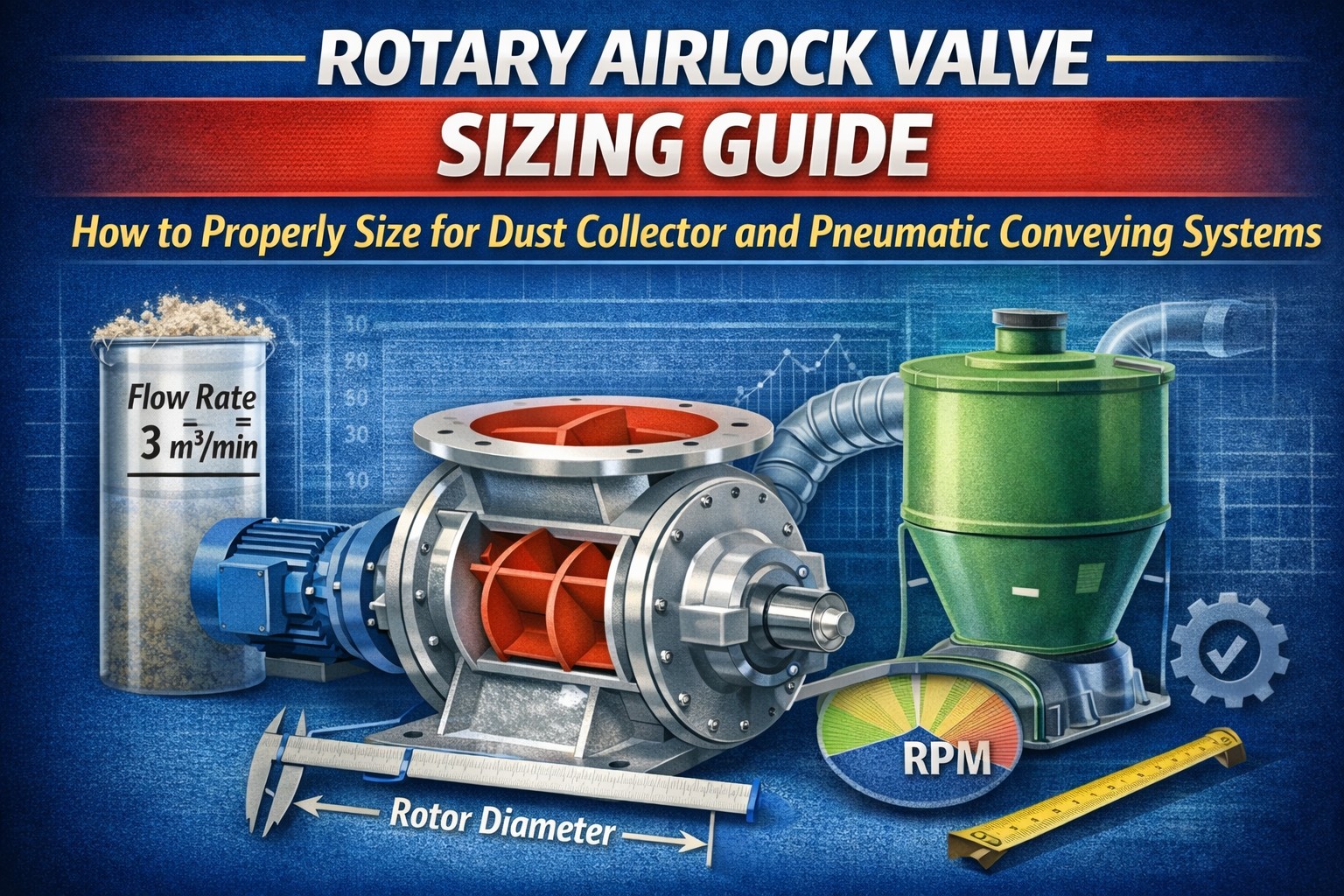
Correct sizing of rotary airlock valve is very important cosine it is the only assurance we have for reliable performance of our dust collection and pneumatic conveying systems. If you size the rotary airlock valve incorrectly, it may result in more air leakage, reduced material throughput, early wear, or even safety risks especially in combustible dust environments which are mainly found in food processing pharmaceuticals chemicals, and woodworking facilities in the USA.
Rotary airlock valve in dust collectors is the one that controls vacuum integrity while at the same time releasing the collected fines from hoppers. In pneumatic conveying, it is the valve that introduces bulk materials into pressurized lines and at the same time prevents blowback. Understanding rotary airlock valve sizing parameters such as volumetric capacity, pressure differential, material characteristics, and rotor speed is critical to achieving a fine balance between efficiency and downtime reduction.
Based in USA and with in-house engineering expertise, Airlock Genius is a manufacturer of 304/316 stainless steel rotary airlock valves for demanding applications. This guide is a step-by-step tutorial for rotary airlock valve sizing, containing formulas, major considerations for dust collection and conveying, and examples.
Key Factors in Rotary Airlock Valve Sizing
Several variables influence rotary airlock valve sizing:
- Material bulk density (lb/ft³ or kg/m³)—measured on-site for accuracy.
- Required throughput (mass rate, e.g., lb/hr or tons/hr).
- Valve efficiency/fill factor (E, decimal 0.65–0.95)—accounts for incomplete pocket filling.
- Rotor speed (RPM)—typically 15–40 RPM to avoid centrifugal effects or excessive wear.
- System type—drop-through for dust collectors; blow-through for pneumatic conveying.
- Pressure differential—higher pressures reduce fill efficiency due to leakage.
For dust collection, focus on low leakage and NFPA compliance. In pneumatic conveying, prioritize pressure sealing and consistent metering.
Step-by-Step Sizing Process
Step 1: Determine Required Volumetric Capacity
Convert mass rate to volume using bulk density and efficiency:
C = R / (D × E)
Where:
- C = Required volumetric capacity (ft³/hr or m³/hr)
- R = Required conveying rate (lb/hr or kg/hr)
- D = Bulk density (lb/ft³ or kg/m³)
- E = Efficiency/fill factor (decimal)
For positive pressure conveying, de-rate E to 0.65–0.70 due to air leakage. Gravity-fed dust collector applications often use 0.80–0.90.
Step 2: Calculate Capacity per Revolution
Divide by rotor speed:
Capacity per rev = C / (S × 60) (ft³/rev, since 60 min/hr)
Select a valve size from manufacturer tables with sufficient swept volume per revolution at your target RPM.
Step 3: Choose Valve Type and Features
- Dust collection: Drop-through design, outboard bearings, tight clearances (0.004–0.006 in) for NFPA compliance.
- Pneumatic conveying: Blow-through or drop-through with adapter; consider 10-vane rotors for reduced leakage at higher pressures (up to 15–20 PSIG).
Reference standards like NFPA 660 for dust hazard isolation requirements, including rotor-to-housing clearances under 0.0079 in and multiple vanes in contact.
(Insert chart of typical rotary airlock valve capacities by size here. Alt text: Rotary airlock valve sizing chart showing cubic feet per revolution vs. valve diameter for dust collection and conveying)
Step 4: Validate for System Conditions
- Measure actual bulk density.
- Account for abrasiveness (upsize for lower RPM).
- Ensure compliance: Outboard bearings, flame propagation barriers if needed.
Example 1: Dust Collector Application (Imperial Units)
A woodworking dust collector needs to discharge sawdust at R = 6,000 lb/hr, bulk density D = 20 lb/ft³, efficiency E = 0.85 (good flow, vacuum system).
C = 6,000 / (20 × 0.85) = 6,000 / 17 = 353 ft³/hr
At S = 20 RPM:
Per rev: 353 / (20 × 60) ≈ 0.294 ft³/rev
Select an 12–14 inch valve with ~0.3 ft³/rev capacity. This ensures reliable discharge without excessive speed or leakage.
Example 2: Pneumatic Conveying System (Metric Units)
Conveying plastic pellets at R = 8,000 kg/hr, density D = 550 kg/m³, E = 0.70 (positive pressure, some leakage).
C = 8,000 / (550 × 0.70) = 8,000 / 385 ≈ 20.8 m³/hr
At S = 25 RPM:
Per rev: (20.8 / 60) / 25 ≈ 0.0139 m³/rev (~13.9 liters/rev)
Choose a blow-through model matching this volume, with pressure rating for the system.
(Insert photo of blow-through rotary airlock valve here. Alt text: Blow-through rotary airlock valve sized for pneumatic conveying system with adapter connection)
Common Sizing Mistakes to Avoid
- Ignoring pressure effects on fill factor.
- Using theoretical 100% fill without de-rating.
- Oversizing (increases leakage) or undersizing (causes backups).
- Neglecting material abrasiveness or NFPA requirements in dust applications.
Conclusion
Effective rotary airlock valve sizing ensures optimal material flow, pressure sealing, and system safety in dust collection and pneumatic conveying. Start with accurate bulk density and throughput, apply the formula C = R / (D × E), adjust for efficiency and RPM, then select based on application type and compliance needs.
Proper sizing reduces energy costs, extends equipment life, and prevents costly downtime. As a trusted USA-based manufacturer, Airlock Genius offers expert support and customizable rotary airlock valves for your specific requirements.
Explore our rotary airlock valve sizing resources or get personalized recommendations.
Ready to size the right valve for your dust collector or conveying system? Contact our team for a free consultation on your rotary airlock valve sizing needs.
Frequently Asked Questions
How does pressure differential impact rotary airlock valve sizing?
Higher differentials reduce fill efficiency; de-rate E to 65–70% in positive pressure systems to account for leakage.
What clearances are required for NFPA-compliant rotary airlock valves in dust applications?
Rotor-to-housing clearances should stay under 0.0079 inches, ideally 0.004–0.006 inches, with multiple vanes in contact.
Should I upsize for abrasive materials?
Yes—larger valves allow lower RPM, reducing wear while maintaining capacity.
How often should bulk density be verified for accurate sizing?
Always measure on-site, as variations in moisture or compaction affect calculations significantly.